

“What are you working on?”
“A sort of commentary on the letter to Philemon.”
“Philemon? The short letter Paul wrote to the slave owner?”
“That’s the one.”
“Philemon has always struck me as odd.”
“In what way?”
“It doesn’t seem like ‘Scripture.’ It seems like an afterthought, as though whoever was putting together the New Testament was desperate to find anything authentically Pauline, no matter how marginal, and someone came up with this little scrap of a letter, so he tacked it on at the end, just for the sake of completeness. It’s like finding a grocery receipt tucked into a great novel. Frankly, I’ve never understood why such a personal, inconsequential letter should be considered Scripture alongside masterpieces like Genesis, Romans, the Sermon on the Mount, or Jesus’ parables.”
“Like the Parable of the Prodigal Son?”
“Exactly! Now that’s a great example of a grace-saturated, life-changing story. You’ll never think of God in the same way after hearing it. You can see why it would be included in Scripture. But Philemon? What does Philemon offer?”
“Are you open to a different perspective?”
“Sure.”
“What if I told you that Philemon was a real-life example of the Parable of the Prodigal Son?”
“Really?”
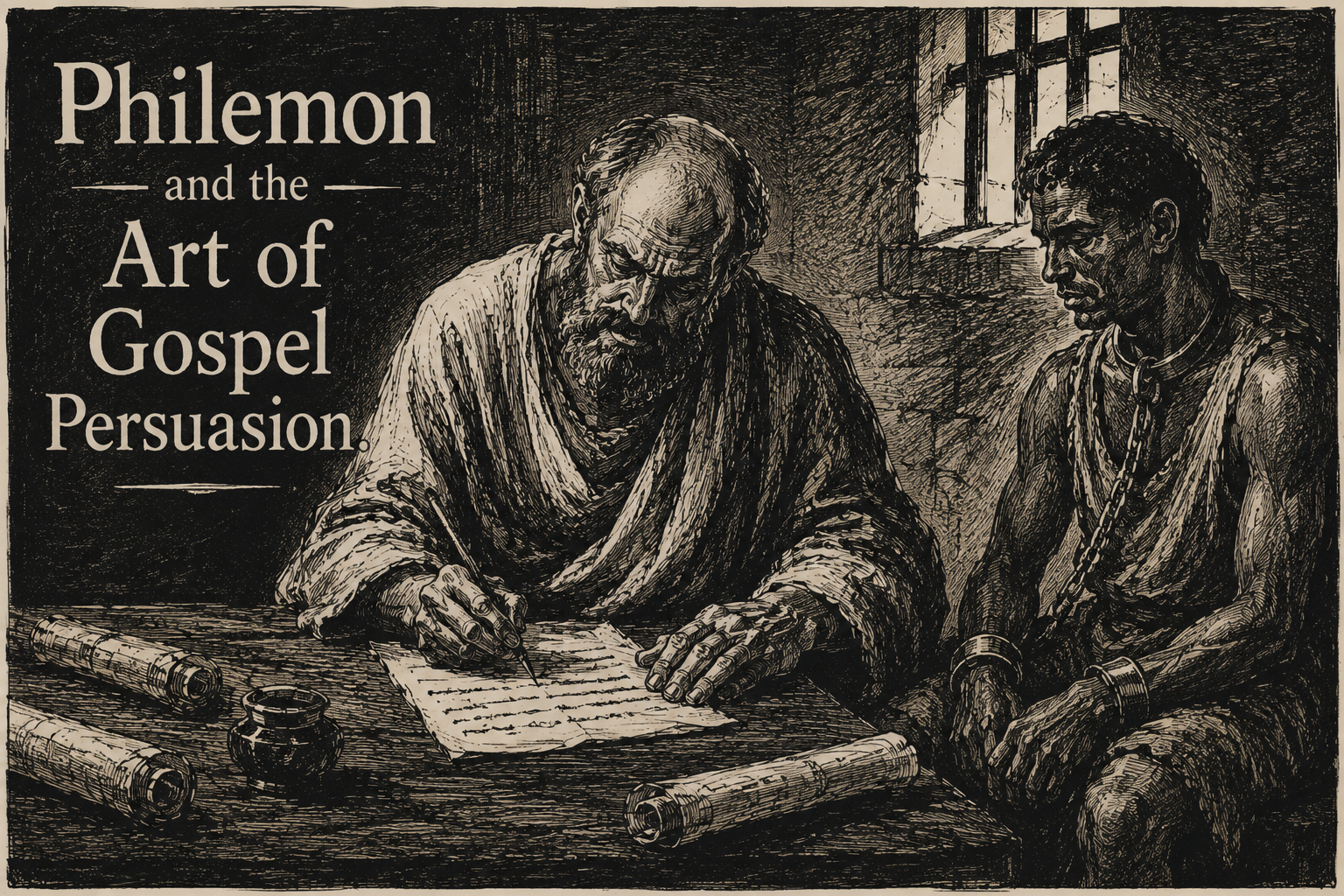
“What I’m going to say is a bit speculative. We don’t exactly know the background story that gave rise to this letter, but I’m going to assume the traditional interpretation that Onesimus is Philemon’s runaway slave. Philemon plays the role of the wealthy father. He must have been wealthy because he owned slaves and a house big enough to host a church. Onesimus is the prodigal. Just as the prodigal left home with the father’s inheritance, Onesimus ran away from home and stole from Philemon. The son went to a faraway land. Onesimus ran to Rome. The son spent all his wealth, and Onesimus apparently spent whatever he stole from Philemon. And just as the prodigal ‘came to his senses’ in a pig stable and longed to return home as a servant, Onesimus came to faith in Christ in Paul’s prison and was ready to return home as a slave.”
“I had never thought of it like that. But in the parable, we know the father welcomes the prodigal back as a son—albeit alive from the dead.”
“And that’s exactly what Paul hopes Philemon will do for Onesimus, but it’s not certain that he will.”
“Ok, those details line up. But you’re missing a character. Who’s the older brother?”
“Let me clarify, I’m not saying this is a one-to-one equivalence between the parable and Philemon. But, who is the older brother? The older brothers was unhappy about his brother coming back. And that’s the key tension of the letter. How will Philemon respond to Onesimus’ return? Will he be like the father who welcomes the prodigal with open arms, or will he be like the bitter older brother? Will he throw a party or send for the police? Under Roman law, Onesimus could be crucified.”
“Crucified!”
“Yes. The Romans wanted to strongly discourage slaves from running away. And that’s significant in itself. The cross is in the background of all of this conversation.”
“So, Onesimus was a dead man walking.”
“He was—unless Philemon welcomed him back as alive from the dead.”
“What role does Paul play?”
“Imagine if, after coming to his senses, the prodigal had asked a friend for help coming up with what to say to his father. That’s what Paul is doing for Onesimus. Making the case. The way I see it, Paul’s letter is a toolkit for the art of gracious persuasion.”
“Meaning?”
“Meaning, Paul could have just ordered Philemon to take him back. After all, he was an apostle, and Philemon was the leader of a house church—probably of a church Paul had planted. If Paul commanded it, Philemon would have to obey—or there would be consequences.”
“But if Paul forced him to take Philemon back, I could imagine it would cause long-term trouble in that church, not least for Onesimus. Philemon would be bitter and resentful. Onesimus wouldn’t have a good time of it. He’d probably want to run away again.”
“I think so. Which is why Paul makes a point of saying that he doesn’t want to command Philemon to do anything. ‘Therefore, although in Christ I could be bold and order you to do what you ought to do, yet I prefer to appeal to you on the basis of love’ (vv 8-9). Yes,Paul wanted Philemon to do the right thing, but not begrudgingly. He wanted him to act out of love.”
“Love, not duty.”
“And Paul wants it to be voluntary. He could have played the apostle card, but he didn’t. ‘But I did not want to do anything without your consent, so that any favor you do would not seem forced but would be voluntary’ (v 14). So, there’s the pastoral question: how do you get someone to do something out of voluntary love? That’s what Philemon is an example of. It’s Paul putting gracious persuasion in action.”
“So voluntary love, not coerced duty. In other words, it’s a question of the ‘law and gospel’ stuff you’re so fond of talking about?”
“It is! How can Paul get Philemon to take Onesimus back without using the threat of law and authority?”
“Well, how?”
“Paul doesn’t rely on just one argument. He makes appeal after appeal, many of which touch on a different aspect of Philemon’s identity in Christ. All of Paul’s appeals are examples of ‘gospel motivations.’”
“Explain that concept to me again.”
“You’ve got legal motivations and gospel motivations. Think of a legal motivation as having a conditional if-then structure. As in: if you obey, then you will get this or that blessing.”
“And if you disobey, then you’ll get the appropriate curse.”
“Exactly. But a gospel motivation has a different structure. Instead of a conditional if-then, it uses an unconditional because-therefore.”
“Give me an example.”
“Think of something Paul wrote to Philemon’s home church, the Colossians. ‘Therefore, as God’s chosen people, holy and dearly loved, clothe yourselves with compassion, kindness, humility, gentleness and patience’ (3:12). Paul reassures the Colossians that they’re already chosen, holy and dearly loved by God. That’s a fact of who they are in Christ. That’s their gospel identity. And because that’s already true of them, ‘therefore’ they should clothe themselves with the virtues of compassion and kindness and humility. See the difference?”
“I think so. If Paul were using a legal motivation there, he would have written something like, ‘If you want to be holy, loved, and chosen, then you better start producing the virtues…or else!”
“That’d be my legalistic default. But I’m trying to wrap my head around these appeals grounded in the gospel. A gospel motivation reminds you of who you are, and of God’s amazing grace towards you in Christ, and then appeals to you to live out of that reality, without making it a law.”
“And that’s what Paul does in Philemon?”
“It seems that way to me.”
“Ok, walk me through what he says.”
“Let me show you what I’ve written. I see about twelve appeals in all.”
Paul, a prisoner of Christ Jesus, and Timothy our brother, To Philemon our dear friend and fellow worker—also to Apphia our sister and Archippus our fellow soldier—and to the church that meets in your home (vv 1-2).
Paul was facing a life-or-death pastoral problem. The whole issue could have been framed in terms of a merciless legal dispute between rivals. But instead of using the old world’s categories of enemy, plaintiff, and defendant, in the opening verses, Paul alludes to his own unjust legal troubles and emphasizes how he and Philemon were dear friends. He includes other Christian workers in his address. They were all in the fight together, even if Paul was currently bearing the brunt of the persecution. Clearly, the issue Paul was about to raise in the letter was not a matter between strangers, but between family, in the context of their shared ministry in Jesus Christ. The deepest truth was not the conflict but their communion in Christ.
Acceptance, rather than accusation, lowers people’s defenses. When we know we are loved, we are more willing to love in return.
Grace and peace to you from God our Father and the Lord Jesus Christ (v 3).
Next, Paul gives Philemon a blessing, reminding him of the undeserved mercy he had received from God in Christ and continues to receive as an abiding daily reality. If we ever insisted on being judged by God based on what our behavior actually deserved—that is, if we insisted on receiving God’s justice on the basis of meticulous scorekeeping—we would experience His wrath, not peace.
That’s what all of us deserve. But thanks to God’s gracious one-way love in Christ, judgment fell elsewhere, and we receive grace and peace. Ideally, the more we recognize and internalize the truth of how we were shown grace by God, the more we will be predisposed to extend it to others. The forgiven forgive.
I always thank my God as I remember you in my prayers, because I hear about your love for all his holy people and your faith in the Lord Jesus. I pray that your partnership with us in the faith may be effective in deepening your understanding of every good thing we share for the sake of Christ. Your love has given me great joy and encouragement, because you, brother, have refreshed the hearts of the Lord’s people (vv 4-7).
Paul wants Philemon to know that he has been praying for him and giving thanks to God for the love that Philemon has for all God’s people (a group that now includes Onesimus!). He prays that Philemon’s partnership in the faith may become even more effective or energized. If he has any faults to correct or sins to repent of, Paul doesn’t bring them up. It’s all praise. Paul is labeling Philemon a certain way—imputing love and faith to him.
Appealing to someone’s identity in Christ is a much better motivator of gracious behavior than is exposing their failures. People prefer acting consistently with their identities. This isn’t manipulation, but good gospel psychology.
It is as none other than Paul—an old man and now also a prisoner of Christ Jesus—(v 9).
Paul refers to himself as an old man and reminds Philemon that he is a prisoner “of Jesus Christ,” meaning he’s suffering on behalf of the gospel—and therefore, suffering unjustly. But he’s not embarrassed by his imprisonment. He’s inviting Philemon’s compassion. Philemon was a beneficiary of Paul’s ministry, and as a preacher of the gospel himself, had no doubt experienced some of the legal dangers associated with being an unprotected religious minority. Appealing to his chains subtly increases the moral weight of Paul’s request.
Humility and vulnerability help to lower another person’s defenses and give one a better chance of reaching their heart than intimidation.
that I appeal to you for my son Onesimus, who became my son while I was in chains. Formerly he was useless to you, but now he has become useful both to you and to me. I am sending him—who is my very heart—back to you. I would have liked to keep him with me so that he could take your place in helping me while I am in chains for the gospel. (vv 10-13).
Paul finally raises the issue of Onesimus. And he immediately challenges Philemon’s perceptions of who Onesimus was. Whatever he used to be, Onesimus had undergone a change. He was no longer “useless” (the literal meaning of his name), nor simply a “runaway slave,” but had become Paul’s “son.” He had become family. Somehow Onesimus had found his way to Rome, then to Paul, and had come to faith in Jesus. As a believer, he now enjoyed all the benefits that come from being “in Christ”—he was forgiven, justified, and born from above. If he was Paul’s spiritual son, then he was also part of the same family of God that Philemon belonged to. Reframing Onesimus as a son, rather than a slave, invites Philemon to respond to him with grace and hospitality.
Appealing to someone’s new identity in Christ is more effective in changing hearts than digging up the sins of their past.
Perhaps the reason he was separated from you for a little while was that you might have him back forever—(v 15).
Philemon could have viewed the whole situation in a self-centered way, as an example personal betrayal and loss. But Paul points outside of their human purposes and appeals to God’s greater purposes. Paul suggests there was a divine purpose in Onesimus’ flight from Philemon’s household. Perhaps the reason these events happened was precisely so that Onesimus could meet Paul, believe in Jesus, be saved, and return home to Philemon as something better than before.
What might appear to be a punishable outrage may, in fact, be yet another example of God’s gospel comedy, writing stories no editor would approve.
no longer as a slave, but better than a slave, as a dear brother. He is very dear to me but even dearer to you, both as a fellow man and as a brother in the Lord (v 15).
Whatever Onesimus used to be, he now had a new identity. God’s verdict on him was the same as that on Paul or Philemon: “Not guilty!” Since coming to faith in Jesus, he had become part of the family of God. And that meant he was no longer a mere slave, but a dear brother to Paul and Philemon.
Recognizing that someone shares a family identity should weaken the harsh, legalistic hostility we often show to strangers who have hurt us. Family is treated differently from strangers.
So if you consider me a partner, welcome him as you would welcome me (v 17).
If the gospel is about anything, it is about God’s welcoming sinners home. That’s what the Parable of the Prodigal Son illustrates so powerfully—how the Father welcomes home the errant son with open arms, and no conditions, kills the fatted calf, and throws a party because his son, who had been dead, was now alive. But even here, Paul invites Philemon to welcome Onesimus under a borrowed identity—as though he were welcoming Paul himself.
If he has done you any wrong or owes you anything, charge it to me. I, Paul, am writing this with my own hand. I will pay it back—not to mention that you owe me your very self (vv 18-19).
When Onesimus fled, it cost Philemon something. It is likely that Onesimus stole from his master. People can find it especially hard to forgive when money is involved. Financial debts can keep resentments alive. So Paul volunteers to pay back Onesimus’ debts. He takes them upon himself and absorbs the debt. Paul closes the account, allowing for a clear path home.
Vengeance and resentment depend on unpaid debts. Forgiveness becomes psychologically easier when someone else bears the cost.
I do wish, brother, that I may have some benefit from you in the Lord; refresh my heart in Christ. Confident of your obedience, I write to you, knowing that you will do even more than I ask (vv 20-21).
Philemon was known for refreshing the people of God, and Paul is asking for him to refresh his heart by taking Onesimus back. Rather than threatening or commanding Philemon, he imputes obedience to him. Instead of predicting failure, he predicts success and generosity. What was the “even more” that Paul expected Philemon to do? Perhaps it was freeing him from slavery, or sending him back to assist Paul, or simply exceeding Paul’s expectations in some other way.
People often grow into the person that trusted mentors believe they can become. In that way, imputation often calls forth the response of spontaneous virtue, much more than expressing suspicion ever could.
And one thing more: Prepare a guest room for me, because I hope to be restored to you in answer to your prayers (v 22).
Paul planned to visit. This isn’t a threat, so much as an expression of confidence. Paul acts as though the reconciliation between Philemon and Onesimus has already happened. And eternally speaking, it has, in Christ, who reconciled the world to God. Paul is so confident that Philemon will do the right thing that he requests that a guest room be prepared for him.
Living in the reality of our reconciliation in Christ and expecting grace to triumph can strengthen others’ resolve to live out the same truth.
Epaphras, my fellow prisoner in Christ Jesus, sends you greetings. And so do Mark, Aristarchus, Demas and Luke, my fellow workers. The grace of the Lord Jesus Christ be with your spirit (vv 23-25).
Paul sends greetings from his friends and fellow workers. Ultimately, this is not a private matter between two individuals but a matter for the church community.
Grace is never private. The church is a resurrection community—a place for prodigal sons and daughters who found their way back home, where people from all walks of life get to begin again. Grace is socially embodied.
_________________
“I stand corrected. I can see now that Philemon is not just a throwaway letter. It’s a case study in grace.”
“I’m glad I could convince you.”
“You said Paul was writing to persuade Philemon, but I think he’s doing something even more.”
“What more?”
“I think he’s performing the gospel. He’s ‘doing’ the gospel to Philemon.”
“What do you mean?”
“Paul isn’t just making an argument—he’s treating him a certain way—the way that God treats sinners.”
“Keep going.”
“Well, as you’ve just shown me, Paul is treating Philemon as righteous before he behaves righteously towards Onesimus, trusting him before he’s trustworthy, and expecting generosity before he’s shown it. It’s all imputation, isn’t it?”
“Yes, that’s right! Philemon is a practical demonstration of what it looks like to preach the gospel without preaching a sermon, and then trusting people to become what they have already been declared to be in Christ.”
“You’ve convinced me that Philemon is more important than I assumed. But I want to challenge a couple of details.”
“Which are?”
“You suggested Philemon plays the role of the father in the parable. I don’t think he is. I think Paul is the father and that Philemon is really the older brother. Do you remember the part in the parable where the father explains to the elder son why he welcomed the prodigal home? That’s this letter. That’s Paul explaining to Philemon why he should welcome Onesimus home. ‘But we had to celebrate and be glad, because this brother of yours was dead and is alive again; he was lost and is found.’”
“You know? You might be right. Anything else?”
“Yes. You left out the fatted calf.”
“Jesus!”
“Exactly.”
“So, have I made the case? Would you still call Philemon an afterthought?”
“It’s not an afterthought—it’s an invitation for every older brother to come join the party!”
__________________________________
Shawn Lazar (DPT, McMaster Divinity College) is the pastor of Gateway United Baptist Church in Denton, TX. Purchase his book One-Point Preaching here and his latest book Once Saved Always Saved? here.

