

What's the most amazing thing you've ever seen? Maybe your top ten most incredible sights would beat mine. For me, my list isn't all that impressive: I recently saw a bald eagle dive for a fish in a lake while it was raining. Not uncommon, but a neat sight. A few months ago, I took my sons to a monster truck rally. It was wheeled insanity, and quite a sight. A few years ago, I took a hot-air balloon ride and saw the city from tree-top level. I've been on some mission trips and seen exotic places like the Great Wall of China, temples in India and Thailand, and a remote stone age village in the mountains of a remote Pacific island.
By this point in Revelation, John has already seen an incredible sight, that of Christ appearing in his didactic glory, but he's in store for so much more in the chapter. What he will behold in Chapter Four is sure to top anyone's top ten list of most incredible sightings.
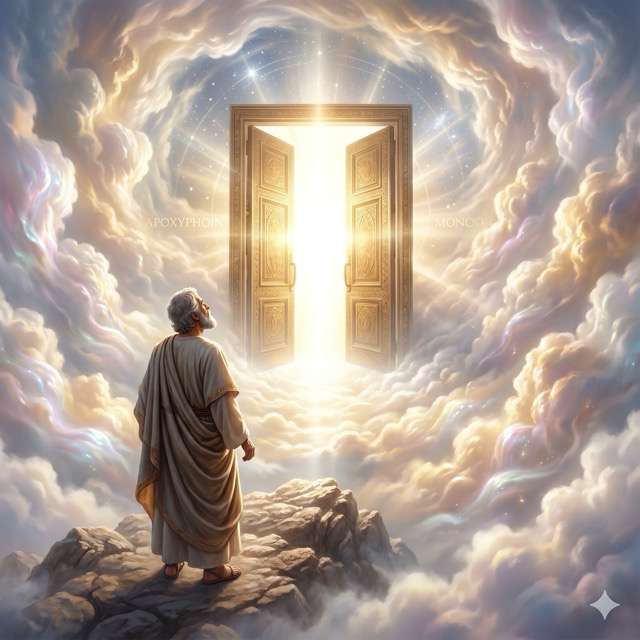
In this lesson, we’re stepping through the open door of Revelation 4, shifting our focus from earthly churches to the breathtaking reality of the celestial throne room. This chapter serves as a theological anchor, grounding us in the absolute sovereignty of God before the complexities of the unfolding vision begin. Amidst flashes of lightning and the roar of thunder, we encounter the mysterious twenty-four elders and four winged creatures—vivid imagery that forces us to grapple with the tension between literal reality and profound symbolism. Ultimately, this scene establishes the ultimate priority of the universe: a call to recognize God’s authority and join the heavenly host in casting our "crowns" before the Creator of all things.
After these things I looked, and behold, a door standing open in heaven. And the first voice which I heard was like a trumpet speaking with me, saying, “Come up here, and I will show you things which must take place after this.”
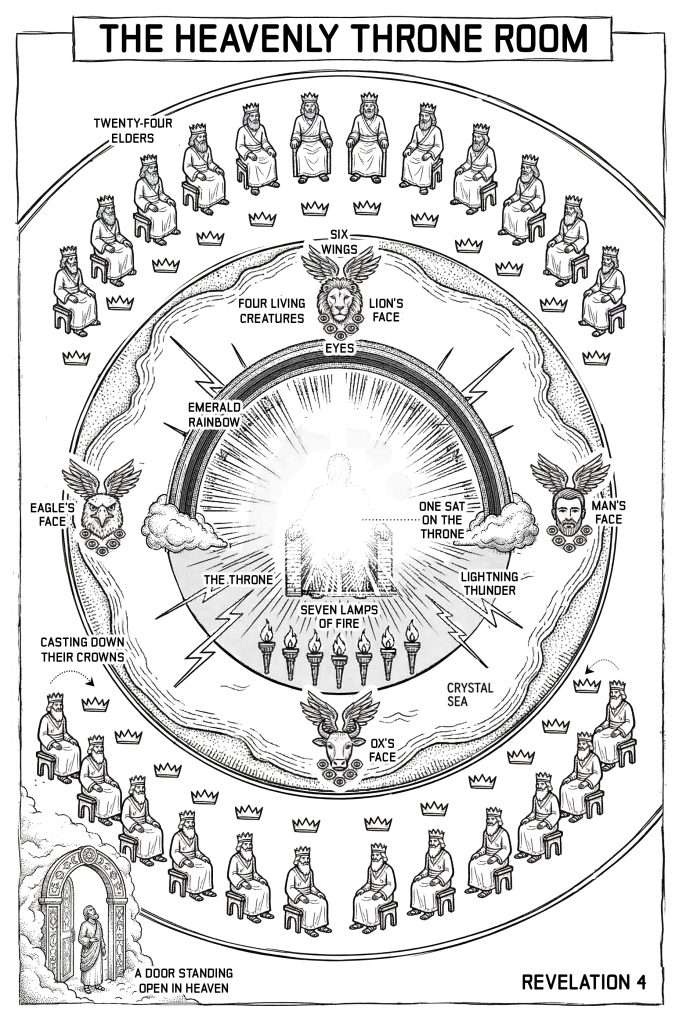
Immediately I was in the Spirit; and behold, a throne set in heaven, and One sat on the throne. And He who sat there was like a jasper and a sardius stone in appearance; and there was a rainbow around the throne, in appearance like an emerald. Around the throne were twenty-four thrones, and on the thrones I saw twenty-four elders sitting, clothed in white robes; and they had crowns of gold on their heads. And from the throne proceeded lightnings, thunderings, and voices. Seven lamps of fire were burning before the throne, which are the seven Spirits of God.
Before the throne there was a sea of glass, like crystal. And in the midst of the throne, and around the throne, were four living creatures full of eyes in front and in back. The first living creature was like a lion, the second living creature like a calf, the third living creature had a face like a man, and the fourth living creature was like a flying eagle. The four living creatures, each having six wings, were full of eyes around and within. And they do not rest day or night, saying:
“Holy, holy, holy,
Lord God Almighty,
Who was and is and is to come!”
Whenever the living creatures give glory and honor and thanks to Him who sits on the throne, who lives forever and ever, the twenty-four elders fall down before Him who sits on the throne and worship Him who lives forever and ever, and cast their crowns before the throne, saying:
“You are worthy, O Lord,
To receive glory and honor and power;
For You created all things,
And by Your will they exist and were created.”
Revelation 4 invites us to step into the throne room of heaven, an awe-inspiring vision full of vivid imagery and deep symbolism. This chapter marks a major shift in the book, moving from letters to the churches into the realm of future events. As John is called up into heaven, the focus turns to worship, God’s sovereignty, and the anticipation of His unfolding plan. Along the way, we encounter profound theological questions: Who are the twenty-four elders? What is the significance of the living creatures? Is this vision symbolic or literal? And perhaps most intriguingly, does this chapter hint at the rapture? While Revelation doesn’t give us a clear timeline for end-time events, chapter 4 sets the stage for the tribulation period and offers a powerful glimpse of heaven’s glory.
One common question about the book of Revelation is: where does it talk about the rapture? You might think that a book focused primarily on the tribulation period would clearly identify the moment of the rapture. But it doesn’t—at least not explicitly. There are passages where Bible teachers suggest the rapture might be referenced, but that’s about as definitive as we can get.
To give a sense of the timeline from what we believe about the end times, there are three basic periods. First, the tribulation, which lasts seven years and is divided into two parts. We take the position that the rapture happens right before the tribulation begins. There are other views on this, but we won’t cover those here. Following the tribulation is the millennial kingdom, which lasts 1,000 years, and then comes the eternal state.
Here’s the important thing to understand: Revelation doesn’t provide this timeline explicitly. It doesn’t lay out when all of these events happen or how they fit together. Much of what we know comes from other books of the Bible. Revelation focuses heavily on the tribulation itself, and we have to piece together the timeline from other scriptures.
The first few verses of chapter 4, which we’re about to look at, are one of the places where some Bible teachers believe the rapture might be referenced. It’s a natural spot because it marks the beginning of the intense events that follow.
Chapter 4 introduces a new location. Think about watching a movie where the story shifts from one setting to a completely different one—that’s what’s happening here.
In a previous session, we talked about how Jesus told John to write down three categories of things: first, what he had seen; second, what was happening at that time in the churches; and third, what would happen in the future. This third section begins here and continues throughout the rest of the book. It focuses on the events that are to come further along the timeline.
“After these things I looked, and behold, a door standing open in heaven, and the first voice which I had heard, like the sound of a trumpet speaking with me, said, ‘Come up here, and I will show you what must take place after these things’”(Revelation 4:1).
This recalls what Jesus said earlier: John would write about the things that would happen after the current events. Here, John describes seeing a door standing open in heaven and being pulled up into this vision.
Some Bible teachers who believe the rapture will occur before the beginning of the tribulation period think this moment represents the rapture (1 Thessalonians 4:16-17, 1 Corinthians 15:51-52). Other Bible teachers are not convinced. One thing is for sure: John at least is being “caught up” into heaven in this vision.
John is told he will now see events that are to come—things that will happen after what he has already written. In verse 2, John says:
“Immediately I was in the Spirit, and behold, a throne was standing in heaven, and One sitting on the throne” (Revelation 4:2).
The capitalization of "Spirit" here is significant. In the original manuscripts, all letters were capitalized, so modern translators must determine whether "Spirit" refers to the Holy Spirit or a person’s own spirit. In this case, translators believe John is referring to the Holy Spirit. When John says he was “in the Spirit,” it likely means he was experiencing a prophetic vision enabled by the Holy Spirit.
This is the second time John mentions being “in the Spirit.” The first instance occurs in Revelation 1:10, where he describes being “in the Spirit on the Lord’s Day.” While we don’t know exactly what this phrase means, it likely refers to John entering a state of divine revelation, where God communicates through visions or dreams, as He often did with prophets.
Being in the Spirit raises a common question: is John actually seeing the events of the future, or is this a vision? I lean toward the idea that John is experiencing a vision in the Spirit that represents the future. Whether he is literally seeing these events unfold is unclear. I believe it is a symbolic representation of what will happen. Much of what John describes in this vision appears highly symbolic, representing future realities rather than literal scenes. The phrase, “in the Spirit,” further supports this idea.
John continues:
“And He who was sitting was like a jasper stone and a sardis in appearance; and there was a rainbow around the throne, like an emerald in appearance. Around the throne were twenty-four thrones, and upon the thrones I saw twenty-four elders sitting, clothed in white garments and golden crowns on their heads” (Revelation 4:3–4).
In this vision, John is transported to the throne room of heaven. He sees the throne, with Someone seated on it, described as having the appearance of jasper and sardis stones. A rainbow, resembling an emerald, encircles the throne. Surrounding the throne are twenty-four smaller thrones, occupied by twenty-four elders dressed in white garments and wearing golden crowns. This is a breathtaking and awe-inspiring scene.
John now sees what can be described as the throne room of heaven. In this vision, he is pulled up into heaven and sees the throne. The appearance of the One on the throne (or the throne itself) is described as being like jasper and sardis, with a rainbow around it, like an emerald. The rainbow, emerald in appearance, is likely green, and this is the first thing John notices—the most prominent feature of the scene.
Then John looks around the throne. While we don’t know the scale of what he’s seeing, it seems immense. Around the throne are twenty-four smaller thrones, and seated on them are twenty-four elders, clothed in white garments and wearing golden crowns.
It’s clear that the One on the main throne is God. This is the throne of God in heaven. But the question arises: who are these elders sitting on the twenty-four thrones surrounding God’s throne?
There are different theories about who these elders are. Some parts of this vision seem highly symbolic, while others feel more literal. Sometimes it’s unclear which elements to interpret symbolically and which to interpret literally.
On the symbolic side, these elders could represent all faithful believers who have overcome. There are two clues that point to this interpretation: the white garments and the crowns. We’ve already seen in earlier chapters of Revelation that these are rewards promised to overcomers. Overcomers are described as walking with the Lord in white garments, and they are promised the crown of life. These details suggest that the elders are, at the very least, overcomers. If we take a fully symbolic approach, the twenty-four elders might represent all believers who remain faithful and reign with Christ. This theme of believers reigning with Christ is a recurring one throughout Revelation.
On the literal side, some Bible teachers believe that the twenty-four elders might represent specific individuals who will have leadership roles in God’s kingdom. One theory is that they could include the twelve apostles as well as key figures from the Old Testament, such as leaders of the twelve tribes of Israel. Jesus told the apostles that in the kingdom, they would sit on twelve thrones. However, this raises an interesting question: if John is one of the twelve apostles, and these elders include the apostles, then John would be seeing himself seated on one of the thrones.
Ultimately, it’s hard to say for certain whether these elders are symbolic, literal, or a combination of both. If they are literal individuals, they are still overcomers because God would not place anyone unfaithful in such a position. Either way, these elders are faithful believers. They wear white garments and crowns, signifying their victory in the Christian life. While we don’t know exactly how literal to take this vision, the imagery clearly emphasizes faithfulness and overcoming.
One question that often comes up is whether this vision represents heaven in the future. The answer addresses two things: first, is this heaven? Yes, because the text explicitly states that a door was opened in heaven and John was drawn up into it. Second, is this future? It’s not entirely accurate to say this is only the future. This seems to represent the current reality of heaven at the moment John is seeing the vision. John is seeing what heaven is like, and from this point, he begins to see events that will unfold in the future. One way to think about it is that John is in the heavenly present and is about to witness a long timeline of future events.
Another question that arises is how heaven experiences time. We don’t really know, but there are indications that time exists in some form in heaven. This ties into the larger question of whether John is seeing a completely symbolic vision or literally experiencing heaven. It seems more likely that this is a symbolic vision, but it’s not merely in his imagination. John is seeing a reality represented to him, though it’s hard to determine how much is symbolic and how much is literal.
The twenty-four elders in the vision also raise questions about their significance. The number twenty-four might represent something symbolic. For instance, there were twelve tribes of Israel in the Old Testament and twelve apostles in the New Testament, which together make twenty-four. Some suggest this could signify co-rulers in heaven or divisions of authority. Alternatively, the number twelve is significant throughout Scripture, representing completeness in governance or leadership.
If the twenty-four elders are taken literally, they could represent specific individuals. But if the vision is symbolic, the number might simply emphasize a spiritual truth. It’s clear that this number holds some significance, but exactly what it represents could have a range of interpretations.
Verse 5 describes what happens around the throne:
“Out from the throne come flashes of lightning and sounds and peals of thunder. And there were seven lamps of fire burning before the throne, which are the seven Spirits of God” (Revelation 4:5).
Notice the present tense in this verse. Lightning, thunder, and the seven lamps are actively proceeding from the throne. The seven lamps, which are identified as the seven Spirits of God, are mentioned earlier in Revelation (1:4) and will be mentioned again in chapter 5. As far as we can tell, this is a reference to the Holy Spirit.
When interpreting the seven Spirits of God, we must tread carefully because there are only a few verses that mention this concept, and they remain mysterious. The number seven often symbolizes completeness in Scripture, so it may simply indicate the fullness of the Holy Spirit. However, the exact meaning is uncertain and may remain a mystery until we reach heaven.
In verse 6, John describes more of what he sees:
“And before the throne there was something like a sea of glass, like crystal; and in the center and around the throne, four living creatures full of eyes in front and behind” (Revelation 4:6).
At first, John focuses on the throne and the twenty-four elders. Then, he notices something like a sea of glass in front of and surrounding the throne. Around the throne are four living creatures, unlike anything we’ve seen before.
He continues:
“The first creature was like a lion, and the second creature like a calf, and the third creature had a face like that of a man, and the fourth creature was like a flying eagle” (Revelation 4:7).
It might seem simple at first glance—like a lion, a calf, a man, and an eagle—but it’s much more complex. John elaborates:
“And the four living creatures, each one of them having six wings, are full of eyes around and within; and day and night they do not cease to say, ‘Holy, holy, holy is the Lord God, the Almighty, who was and who is and who is to come’”(Revelation 4:8).
These creatures are not straightforward animals. They have wings—sometimes many wings—and are covered with eyes. One has the face of a man. These creatures are clearly significant, though it’s unclear if they are symbolic or literal. Revelation often swings between the symbolic and the literal, leaving us to ask why God has these specific beings around His throne.
Symbolically, one theory suggests that these creatures represent the multifaceted characteristics of God. For example, the lion could represent God’s power and majesty, while the eagle might symbolize His vision and ability to soar above Creation. The man could represent God’s intellect and rationality far beyond human comprehension. An ox could represent physical strength and stability. If this is the case, these creatures might serve to display the vast attributes of God in a way we can visualize and understand.
On the other hand, they could be literal, tangible beings. God delights in creating, and these creatures may simply be part of the heavenly order. It’s possible that they both mean something symbolically and exist as literal creatures.
It’s clear that the creatures described in Revelation 4 aren’t angels as we typically think of them. Angels in the Bible don’t often appear with wings. In most instances, angels appear as human-like beings—enhanced or glowing, but not necessarily winged. The popular image of angels with wings likely comes from a blending of these messenger angels with the creatures described here, who do have wings.
The creatures in Revelation 4 each have six wings, but they aren’t explicitly identified as angels. They do deliver a message through their song, which could place them in the broader category of "messengers," but they are distinct from the angels we know by name, like Gabriel (a messenger) or Michael (a warrior). These four living creatures clearly have a unique role around God’s throne and are unlike Michael or Gabriel in appearance or function.
The imagery of these creatures may connect to the Ark of the Covenant. The top of the Ark, called the Mercy Seat, is often interpreted as a representation of what exists in heaven. The cherubim on the Ark might symbolize these throne creatures described in Revelation. However, the creatures in this vision are described differently, so it’s uncertain if they are the same beings or simply related.
What is clear is that these creatures are constantly proclaiming:
“Holy, holy, holy is the Lord God, the Almighty, who was and who is and who is to come” (Revelation 4:8).
This raises another question: are they literally saying this continuously, or is this a symbolic representation of eternal worship?
In verse 9, John describes what happens next:
“And when the living creatures give glory, honor, and thanks to Him who sits on the throne, to Him who lives forever and ever, the twenty-four elders will fall down before Him who sits on the throne, and will worship Him who lives forever and ever, and will cast their crowns before the throne, saying, ‘Worthy are You, our Lord and our God, to receive glory and honor and power; for You created all things, and because of Your will they existed and were created’” (Revelation 4:9–11).
Here, we see a beautiful picture of worship. The living creatures glorify God, and in response, the twenty-four elders fall down before Him. They cast their crowns before His throne and proclaim His worthiness.
This interaction feels deeply symbolic. It’s hard to imagine that these elders, who likely represent key figures or faithful believers, would literally do this for all eternity. Instead, this may be a way to teach John—and us—about the proper posture of worship and humility before God. It reminds us of God’s power, creativity, and sovereignty. It emphasizes an important truth: heavenly worship is centered on acknowledging God as Creator and Sustainer of everything that exists.
In Revelation 4, we are drawn into a magnificent scene of worship and divine authority. The One seated on the throne reigns over all creation, surrounded by twenty-four elders and four living creatures ceaselessly proclaiming His holiness. Whether symbolic or literal, this chapter emphasizes God’s power, majesty, and sovereignty. It reminds us of the ultimate purpose of all creation: to glorify God. As we reflect on the throne room of heaven, we are called to align our hearts with this heavenly worship and trust in God’s eternal plan, even when its details remain mysterious. This chapter prepares us for the events to come, anchoring us in the truth of God’s dominion over all things.