What are you currently anticipating?
I still remember the heavy weight of waiting for Christmas morning, or the restless excitement of turning sixteen and the freedom a driver’s license promised. As an adult, looking forward feels more measured, yet life is still filled with that sticky emotion. We wait for tax returns, upcoming vacations, promotions, or—my personal favorite—the simple Friday night ritual of sitting on the couch with my wife, some popcorn, and a movie.
Anticipation is a universal human experience, but it is also a cornerstone of our spiritual reality. Just as we long for small earthly comforts, we look forward to the ultimate fulfillment in the heavenly realm: the return of Christ and the coming of the final judgment. In chapter 5 of Revelation, John experienced this profound shift from expectation to fulfillment as the final events of history began to unfold.
In this lesson, focused on Revelation 5, the scene shifts to a tense moment. God holds a sealed scroll containing His ultimate plan, and John cries because no one in the universe is worthy to open it. The sadness breaks when Jesus appears, described as both a powerful Lion and a sacrificed Lamb. When Jesus steps up to take the scroll, all of heaven breaks out into massive worship—starting with the elders and angels, and eventually including all of creation.
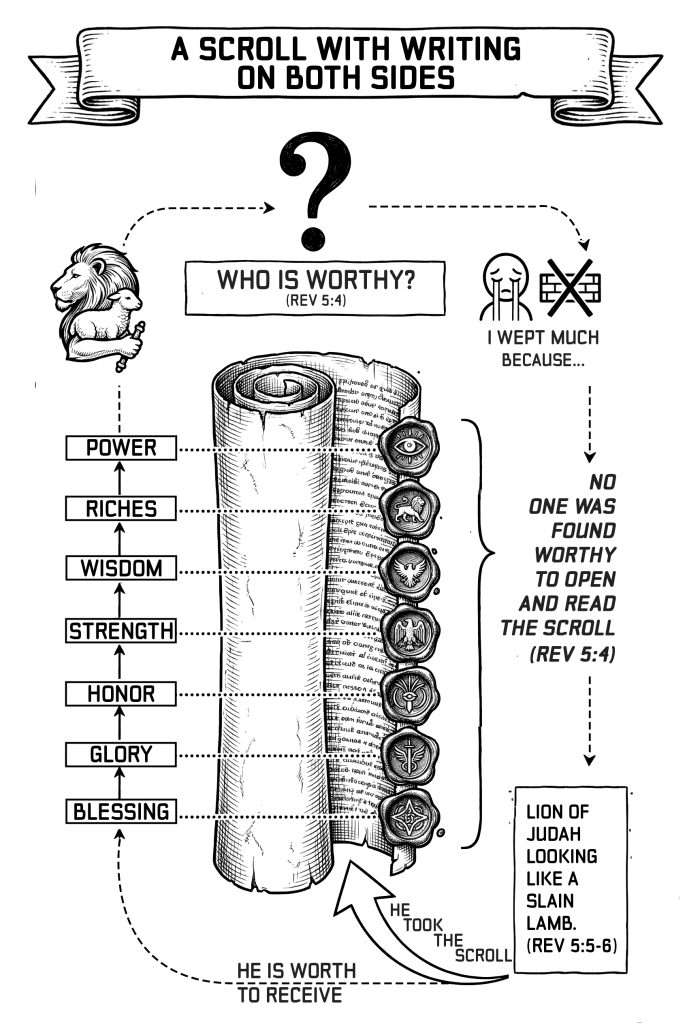
And I saw in the right hand of Him who sat on the throne a scroll written inside and on the back, sealed with seven seals. Then I saw a strong angel proclaiming with a loud voice, “Who is worthy to open the scroll and to loose its seals?” And no one in heaven or on the earth or under the earth was able to open the scroll, or to look at it.
So I wept much, because no one was found worthy to open and read the scroll, or to look at it. But one of the elders said to me, “Do not weep. Behold, the Lion of the tribe of Judah, the Root of David, has prevailed to open the scroll and to loose its seven seals.”
And I looked, and behold, in the midst of the throne and of the four living creatures, and in the midst of the elders, stood a Lamb as though it had been slain, having seven horns and seven eyes, which are the seven Spirits of God sent out into all the earth. Then He came and took the scroll out of the right hand of Him who sat on the throne.
Now when He had taken the scroll, the four living creatures and the twenty-four elders fell down before the Lamb, each having a harp, and golden bowls full of incense, which are the prayers of the saints. And they sang a new song, saying:
“You are worthy to take the scroll,
And to open its seals;
For You were slain,
And have redeemed us to God by Your blood
Out of every tribe and tongue and people and nation,
And have made us kings and priests to our God;
And we shall reign on the earth.”
Then I looked, and I heard the voice of many angels around the throne, the living creatures, and the elders; and the number of them was ten thousand times ten thousand, and thousands of thousands, saying with a loud voice:
“Worthy is the Lamb who was slain
To receive power and riches and wisdom,
And strength and honor and glory and blessing!”
And every creature which is in heaven and on the earth and under the earth and such as are in the sea, and all that are in them, I heard saying:
“Blessing and honor and glory and power
Be to Him who sits on the throne,
And to the Lamb, forever and ever!”
Then the four living creatures said, “Amen!” And the twenty-four elders fell down and worshiped Him who lives forever and ever.
Revelation 5 brings us to a pivotal and deeply moving moment in John’s vision. The scene centers on a scroll, sealed with seven seals, held in the right hand of the One seated on the throne. This scroll represents God’s divine plan for redemption and judgment, but no one in heaven, on earth, or under the earth is found worthy to open it. John weeps at the apparent hopelessness of the moment, but then comes the powerful announcement: the Lion of Judah has overcome and is worthy to open the scroll. What unfolds next is a worship-filled celebration of Jesus as both the Lion and the Lamb, emphasizing His worthiness, power, and sacrifice. This chapter captures the heart of God’s redemptive plan and the universal acknowledgment of Christ’s authority. John continues his description of the vision. He writes:
“I saw in the right hand of Him who sat on the throne a book written inside and on the back, sealed with seven seals”(Revelation 5:1).
The word "book" here could also be translated as "scroll," which was the more common form of a written document in the ancient world. Scrolls were often sealed with wax or clay to prevent unauthorized individuals from opening them. A seal served as a security measure, and breaking it without permission carried consequences. If someone broke the seal on an emperor’s scroll, they might face severe punishment.
John continues:
“And I saw a strong angel proclaiming with a loud voice, ‘Who is worthy to open the book and to break its seals?’ And no one in heaven or on the earth or under the earth was able to open the book or to look into it. Then I began to weep greatly because no one was found worthy to open the book or to look into it” (Revelation 5:4).
This moment is striking. John is overcome with emotion because the contents of the scroll are so important, yet no one is found worthy to open it. The scroll represents something central to God’s plan, and without someone to open it, that plan appears to be at a standstill. John’s heart is fully aligned with God’s will. His desires align perfectly with God’s will. John senses that the scroll must be opened, but no one can do it. This realization overwhelms him emotionally because he deeply desires what God desires.
In verse 5, one of the elders comforts John:
“And one of the elders said to me, ‘Stop weeping; behold, the Lion that is from the tribe of Judah, the Root of David, has overcome so as to open the book and its seven seals’” (Revelation 5:5).
The elder tells John to stop weeping, not because his tears are wrong, but because there is hope. Sometimes, God allows moments of intense emotion to highlight the importance of what is about to happen. John’s tears may represent the longing of God’s people throughout history for the fulfillment of His plan. The scroll, sealed for so long, represents the next step in God’s kingdom plan, and John’s weeping reflects the collective anticipation of believers for God’s ultimate return and reign.
This elder points to the Lion of Judah—Jesus Christ—who is worthy to open the scroll. The fact that an elder speaks directly to John is notable. It highlights the active role these elders play in the vision, whether literal or symbolic.
This passage emphasizes the centrality of Christ in God’s redemptive plan. While no one else in heaven, on earth, or under the earth is worthy to open the scroll, Jesus, the Lion of Judah, can. This moment shifts the focus from John’s grief to the hope and victory found in Christ.
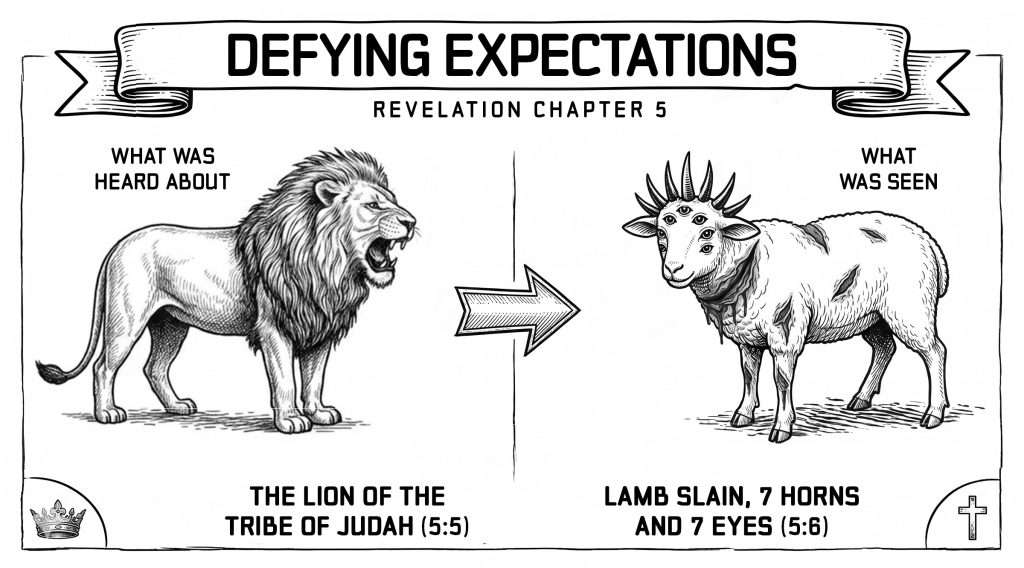
The elder then points John to the one who is worthy to open the scroll. John hears about the Lion of Judah and begins looking for a lion. Is it one of the creatures? No. Is it one of the elders? No. Instead, what John sees is entirely unexpected:
"And I saw between the throne (with the four living creatures) and the elders a Lamb standing, as if slain, having seven horns and seven eyes, which are the seven Spirits of God, sent out into all the earth" (Revelation 5:6).
John expects to see a lion, but instead, he sees a lamb—one that appears to have been slain. This represents one of several places in Revelation where John is told to look, and given expectations for what he will see, but then when he looks the sight that meets his eyes is very different from his expectations (Revelation 1:10-13, 7:4-9, 11:3-11, 17:1-15, 19:-13, 21:9-10). The unexpected lamb is Jesus, who is represented here as both the Lion of Judah and the Lamb who was slain. These two well-known depictions of Jesus are brought together in this powerful image.
The lamb is unlike any ordinary lamb. It has seven horns, symbolizing complete power and authority, and seven eyes, which John explains are the seven Spirits of God sent out into all the earth. This is the final reference in Revelation to the seven Spirits of God (Revelation 1:4; 3:1; 4:5), and it ties the Holy Spirit to this representation of Jesus. It reminds us of the unity of the Trinity: Jesus, the Holy Spirit, and God the Father are one.
The lamb is both meek and powerful. He was slain, representing His sacrifice on the cross, but He has the complete authority to act. His seven eyes symbolize His divine knowledge and presence throughout the world. He knows everything happening in the seven churches, in John’s vision, and throughout the earth. He not only sees but has the power to act.
The image of the horns and eyes also connects to prophecy in Daniel and later in Revelation, where horns are often associated with power. In Daniel, horns are used negatively in reference to beasts, but here they signify the Lamb’s benevolent authority. Horns themselves are neutral—they represent power, and the context determines whether that power is good or bad.
John watches as the lamb takes the scroll:
"And He came and took the book out of the right hand of Him who sat on the throne" (Revelation 5:7).
At the start of this chapter, we see One seated on the throne, and then the Lamb, who is identified as Christ. This raises a question: Is the One on the throne also Jesus? At first, it might seem like it, but notice that the Lamb takes the scroll from the hand of the One seated on the throne. This suggests they are two distinct entities. The One on the throne is most likely God the Father.
If this is correct, then Revelation 5 presents a representation of the Trinity. We have God the Father on the throne, the Lamb (Jesus), and the seven eyes on the Lamb, representing the seven Spirits of God, which we understand to be the Holy Spirit. This chapter beautifully portrays the unity and distinct roles of the Trinity.
The moment the lamb takes the scroll, an incredible scene of worship unfolds:
"When He had taken the book, the four living creatures and the twenty-four elders fell before the Lamb, each one holding a harp and golden bowls full of incense, which are the prayers of the saints. And they sang a new song, saying, ‘Worthy are You to take the book and to break its seals; for You were slain, and purchased for God with Your blood men from every tribe and tongue and people and nation. You have made them to be a kingdom and priests to our God; and they will reign upon the earth" (Revelation 5:8–10).
Here, we see the elders and creatures worshiping Jesus, the Lamb. They hold golden bowls of incense, which represent the prayers of the saints. This imagery suggests that our prayers are like incense in heaven—a pleasing aroma to God. Prayer isn’t just communication; it’s an act that brings delight to God.
The term "saints" is worth clarifying as well. In the Bible, the word "saint" refers to all believers. Through church history, the word has taken on a different meaning, often referring to someone particularly holy or virtuous. Biblically, however, saints are simply those who have been sanctified—those made right with God. This includes all believers, not just a select few.
For example, many New Testament letters begin with greetings to the saints in various cities, such as Colossae or Ephesus. These greetings are addressed to all the believers in those churches, not to a select group of particularly righteous individuals. Being a saint doesn’t mean someone is perfect or sinless; it means they have put their faith in Christ and are set apart for Him.
The elders and creatures sing a new song, celebrating the Lamb’s worthiness, who redeemed humanity through His sacrifice. This song emphasizes Jesus’ work of salvation and His authority to reign.
John then describes an even greater scene of worship:
"Then I looked, and I heard the voice of many angels around the throne and the living creatures and the elders; and the number of them was myriads of myriads, and thousands of thousands, saying with a loud voice, ‘Worthy is the Lamb that was slain to receive power and riches and wisdom and might and honor and glory and blessing’" (Revelation 5:11–12).
The worship spreads as countless angels join in, followed by every creature in existence. It’s worth noting that seven seals will soon be broken, and these angels sing about seven attributes of the Lion/Lamb. The seven attributes make him distinctly worthy to open the seven seals, and thus act as his authorization to take possession of the earth. Because he was slain, he is therefore worthy to receive power, riches, wisdom, might, honor, glory, and blessing.
Some Bible teachers suggest that the sudden appearance of myriads in verse 11 might symbolize the rapture, in which believers are caught up to join in this heavenly worship. While this is one interpretation, it’s not explicitly clear in the text.
And every creature which is in heaven and on the earth and under the earth and such as are in the sea, and all that are in them, I heard saying: “Blessing and honor and glory and power Be to Him who sits on the throne, And to the Lamb, forever and ever!” Then the four living creatures said, “Amen!” And the twenty-four elders fell down and worshiped Him who lives forever and ever. (Revelation 5:13–14)
This chapter closes with a powerful and awe-inspiring vision of worship directed toward the Lamb and the One on the throne. It emphasizes Jesus’ worthiness, His role in God’s redemptive plan, and the universal acknowledgment of His authority. The pattern, which was only mentioned in the previous chapter, is now witnessed in its full cycle. At the conclusion, the four living creatures affirm this worship by saying "Amen," and the elders fall down in reverence.
Revelation 5 is a profound declaration of Christ’s central role in God’s redemptive plan. The imagery of the Lion of Judah and the Lamb who was slain showcases His dual nature as both a conquering King and a sacrificial Savior. The worship of the Lamb by the elders, creatures, angels, and all of creation emphasizes the universal recognition of His worthiness and authority. This chapter reminds us that Christ alone is able to bring God’s plan to completion, offering hope and assurance to believers. It invites us to join in the heavenly worship, proclaiming that Jesus is worthy of all glory, honor, and praise for His victory and sacrifice.
<< PREV | NEXT >>