


In high school, I had a classmate who locked his keys in his car by accident. The campus police officer saw him struggling to get it unlocked and came over to assist. The officer used a slim Jim to get the door open, but my classmate was nervous the whole time, trying to tell the officer he didn’t need help. “Nonsense,” the policeman said. “It’s as easy as this.” He pulled the jig, and popped the door open. As soon as it opened, the overwhelming smell of marijuana wafted out. My pot-smoking classmate got a free ride in the back of the cop’s car and got to try on a set of handcuffs. A parking lot of high school students watched, unable to look away. It was talked about for weeks.
It makes me think of the show Cops, which would be on TV when we arrived home from school. The situations on that show were insane, but the formula was simple. Justice had arrived, and it was nearly impossible to take our eyes off the screen. Maybe it’s a human feature, built into the brain’s psychology. We are intensely interested in justice and judgment, especially witnessing that moment when long-awaited justice is finally served. In this study, we will examine the moment when the final judgment will touch down on the earth.
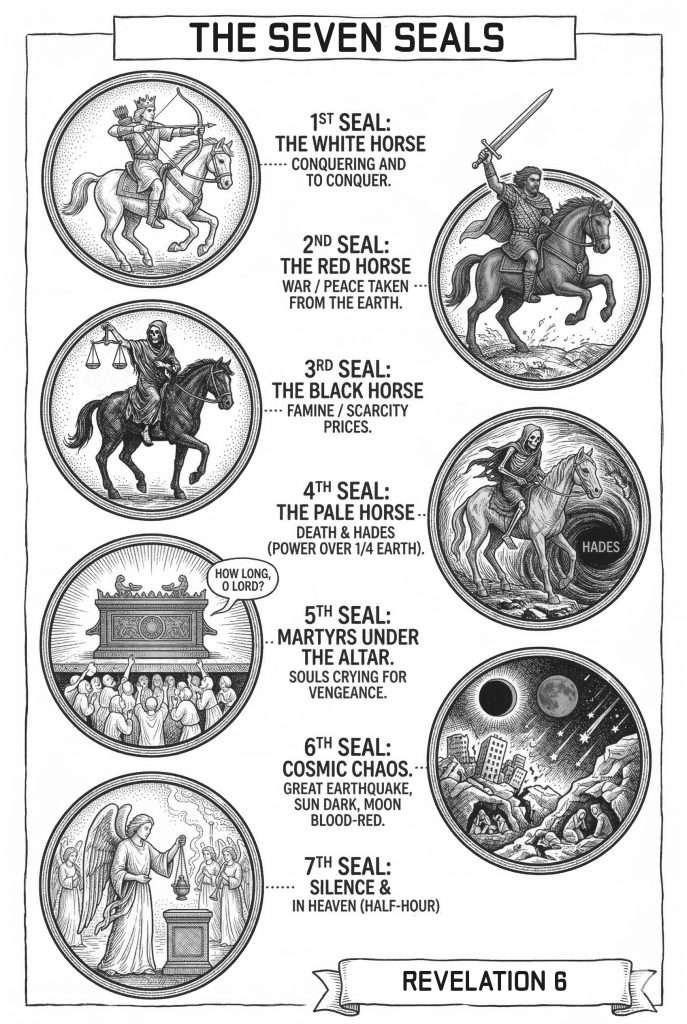
Revelation 6 launches us into the most terrifying and misunderstood period of human history: the seven-year Tribulation. With the breaking of the first six seals, the infamous Four Horsemen are released, bringing global deception, war, unprecedented famine, and widespread death. But how are we supposed to make sense of these apocalyptic judgments?
In this chapter study, you will get a clear look at future events and discover the most important takeaway of all: the Lamb is entirely in control. Step into this vital study to demystify the future and find the clarity you need to live faithfully for Christ today.
Now I saw when the Lamb opened one of the seals; and I heard one of the four living creatures saying with a voice like thunder, “Come and see.” And I looked, and behold, a white horse. He who sat on it had a bow; and a crown was given to him, and he went out conquering and to conquer.
When He opened the second seal, I heard the second living creature saying, “Come and see.” Another horse, fiery red, went out. And it was granted to the one who sat on it to take peace from the earth, and that people should kill one another; and there was given to him a great sword.
When He opened the third seal, I heard the third living creature say, “Come and see.” So I looked, and behold, a black horse, and he who sat on it had a pair of scales in his hand. And I heard a voice in the midst of the four living creatures saying, “A quart of wheat for a denarius, and three quarts of barley for a denarius; and do not harm the oil and the wine.”
When He opened the fourth seal, I heard the voice of the fourth living creature saying, “Come and see.” So I looked, and behold, a pale horse. And the name of him who sat on it was Death, and Hades followed with him. And power was given to them over a fourth of the earth, to kill with sword, with hunger, with death, and by the beasts of the earth.
When He opened the fifth seal, I saw under the altar the souls of those who had been slain for the word of God and for the testimony which they held. And they cried with a loud voice, saying, “How long, O Lord, holy and true, until You judge and avenge our blood on those who dwell on the earth?” Then a white robe was given to each of them; and it was said to them that they should rest a little while longer, until both the number of their fellow servants and their brethren, who would be killed as they were, was completed.
I looked when He opened the sixth seal, and behold, there was a great earthquake; and the sun became black as sackcloth of hair, and the moon became like blood. And the stars of heaven fell to the earth, as a fig tree drops its late figs when it is shaken by a mighty wind. Then the sky receded as a scroll when it is rolled up, and every mountain and island was moved out of its place. And the kings of the earth, the great men, the rich men, the commanders, the mighty men, every slave and every free man, hid themselves in the caves and in the rocks of the mountains, and said to the mountains and rocks, “Fall on us and hide us from the face of Him who sits on the throne and from the wrath of the Lamb! For the great day of His wrath has come, and who is able to stand?”
As we begin to explore the tribulation period let’s remind ourselves of our purpose statement for Revelation:
Consider how the events in this chapter might drive that purpose forward for the reader.
In the previous chapter, we saw a discussion about who could break the seals. John wept because no one was found worthy, but then the Lamb came forward. Songs were sung, and it was determined that the Lamb—representing Christ—could break the seals.
Before we look at the first seal, it’s worth considering the broader pattern in Revelation that begins with chapter six. As we will soon see, there are three series of seven judgments. The first is a series of seven seal judgments (Revelation 6:1–17; 8:1). Second will be the seven trumpet judgments (Revelation 8:2–9:21; 11:15–19). Third will follow the seven bowl judgments (Revelation 16:1–21). These three series of judgments comprise the entirety of the tribulation period. This horrific period will last seven years (Daniel 9:27).
It might seem natural to think these three series of seven judgments align with the seven years, with each event corresponding to a specific year. However, trying to fit them neatly into a timeline year by year is difficult.
A safer interpretive approach might be to view the number seven as literal but also symbolically significant. Seven is often seen as the number of completion in Scripture, representing the perfection of God's plan. The seven days of creation signify the complete creation work. The seven years of tribulation signify the completion of human history before Christ’s return. Similarly, the seven seals, trumpets, and bowls reflect the completeness of God’s judgment.
Most Bible teachers suggest that these events are spread out across the tribulation. Generally, the seals are thought to take place earlier, with the seventh seal occurring toward the end (Revelation 8:1). The trumpets seem to span a broader portion of the tribulation (Revelation 8:6–9:21; 11:15), while the bowls are concentrated in the final segment (Revelation 16:1–21). However, this is still an educated guess, as the exact timeline is not clear.
Because of this difficulty, "futurists"—Bible teachers who believe Revelation describes actual events still in our future—generally look at the chronology of these judgments through one of two lenses: the recapitulation view or the telescoping view.
The recapitulation view, which has been held by many throughout church history, suggests that these three series of judgments aren't strictly chronological. Instead, they "recapitulate" or retell the same period of time from different angles. It's like watching three different camera angles of the same event, with each series building in intensity.
The telescoping view, which is more closely associated with modern dispensationalism, argues for a sequential timeline. In this view, the judgments are nested inside one another like a collapsible telescope. The seventh seal actually contains the seven trumpets, and the seventh trumpet contains the seven bowls.
Either approach falls well within the accepted range of interpretations. There are a few advantages to a limited recapitulation view—meaning the overlapping "camera angles" stop once Babylon falls (Revelation 18), and the text becomes strictly chronological as it moves into a literal 1,000-year kingdom (Revelation 20:1–6) and the eternal state (Revelation 21–22). However, the nested telescoping view is equally valid. Whether you view the judgments as overlapping replays or a sequential timeline, both faithfully honor the text and deliver the reader to the exact same glorious conclusion: the physical return of Jesus Christ (Revelation 19:11–16).
Now, with the opening of chapter six, the tribulation period begins on earth:
Then I saw when the Lamb broke one of the seven seals, and I heard one of the four living creatures saying as with a voice of thunder, “Come.” (Revelation 6:1)
Remember those four living creatures around the throne? Now they’re speaking. Different translations give the impression that the voice’s thundering command to come might be either directing John to come and see or for the first horesman to come.
The seals, unlike the other judgments, are opened by Christ (the Lamb). Angels enact the later judgments in Revelation on God’s behalf but these, only the Lamb is to open them. This difference probably reflects the concept that all judgment is initiated by God, even if an angelic agent ultimately carries it out. In that way, the seals could be seen as the initial command or decree for what will take place throughout the entire Tribulation. In that way, the seals could represent the heavenly proclamation that covers all the remaining actions seen in the rest of Revelation. Some of the similarity between the seals, and later judgments might suggest this is the case.
The result of the breaking of the first seal emerges after one of the heavenly creatures says, “come.”
I looked, and behold, a white horse, and he who sat on it had a bow; and a crown was given to him, and he went out conquering and to conquer. (Revelation 6:2)
The reader is introduced to the first of four riders on horses. There’s some debate among Bible teachers on who this figure represents.
Some interpret this rider as Jesus because he’s on a white horse, wears a crown, and is described as a conqueror. Others, however, view this rider as Satan’s beast, who is sent to conquer the nations of the world. Both positions have valid points.
This debate serves as a good reminder of the challenges of interpreting Revelation. When we encounter a figure like this, it’s easy to get fixated on identifying the character. But instead of focusing solely on who this rider is, we should take a step back and ask, Who is in charge?
It’s the Lamb—clearly representing Christ—who calls this rider forward. The Lamb is in control. God is in charge. The Lamb, with His seven eyes that represent the Spirit of God, knows what He’s doing. Whoever this rider on the white horse may be, we can trust that God has a plan and that everything is unfolding according to His will.
When He broke the second seal, I heard the second living creature saying, “Come.” And another, a red horse, went out; and to him who sat on it, it was granted to take peace from the earth, and that men would slay one another; and a great sword was given to him. (Revelation 6:3–4)
Before the end, the world will be saying, peace and security (1 Thessalonians 5:3). It seems that right before the tribulation begins, the world will achieve some level of peace. What exactly does this peace look like? We can’t say for sure. Is it complete peace—an absence of war and conflict—or is it simply that the treaty Daniel’s prophecy promises will be recently signed (Daniel 9:27)?
Into this hopeful atmosphere of peace comes the rider on the red horse, who takes that peace away. This happens right at the beginning of the tribulation. The peace is ripped away, and the result is chaos. Jesus warns about this period, saying there will be wars and rumors of wars (Matthew 24:6–8). Even if the war doesn’t directly touch every person in this early phase of the tribulation, it will dominate the news. It will be a global crisis, a war that spreads until the entire world is eventually engulfed. Things will escalate quickly from there as people will slay one another.
When He broke the third seal, I heard the third living creature saying, “Come.” I looked, and behold, a black horse; and he who sat on it had a pair of scales in his hand. (Revelation 6:5)
The image of scales in this context is significant. In the ancient world, scales were used to measure and weigh items, often food. Picture a balance scale where weight is placed on one side to measure an item on the other. This symbolizes the scarcity and rationing that are about to take place.
And I heard something like a voice in the center of the four living creatures saying, “A quart of wheat for a denarius, and three quarts of barley for a denarius; and do not damage the oil and the wine.” (Revelation 6:6)
This statement is striking. A denarius was roughly equivalent to a day’s wage in the ancient world. So, to spend an entire day’s earnings on just a quart of wheat—or three quarts of barley—indicates extreme inflation and scarcity. The famine during this time will be unlike anything the world has ever seen. Humanity has experienced devastating famines before, but this one will outstrip them all, and will be global in scale.
However, there is a hint of restraint in this famine. The voice adds, do not damage the oil and the wine. These items—oil and wine—were considered luxury goods. This suggests that while the lower and middle classes, as well as the world’s poor, will bear the brunt of this famine, the wealthy may remain somewhat insulated toward the beginning of the tribulation. This phase of famine will wreak havoc, but it won’t completely destroy the global economy. This might be why we don’t encounter the destruction of Babylon, which represents the world’s center of economic and political power, until nearly the end of the tribulation.
Historically, wars and famines often go hand in hand. Food shortages and resource scarcity are common consequences of conflict, so it’s not surprising that these events unfold together during the tribulation.
When the Lamb broke the fourth seal, I heard the voice of the fourth living creature saying, “Come.” I looked, and behold, an ashen horse; and he who sat on it had the name Death; and Hades was following with him. Authority was given to them over a fourth of the earth, to kill with sword and with famine and with pestilence and by the wild beasts of the earth. (Revelation 6:7–8)
The horse is described as ashen in some translations, pale in others. I picture it as having a sickly, greenish hue—something akin to the look of gangrene. The rider is identified as Death, and trailing behind him is Hades. While Hades is a term from Greek mythology, here it simply refers to the place of the dead—the destination for those who die apart from Christ. In the Old Testament, the place of the dead was thought to have two divisions: one for saints who believed in God and His coming Messiah, and another for the unrighteous. But after Christ's resurrection, believers are said to go directly to be with Him, as Paul teaches (2 Corinthians 5:8). So, at this point, Hades would only refer to the place for those who are not believers.
Death rides through the world like a grim harvester, and those who die are gathered, so to speak, into Hades, like a harvester’s grain cart that trails behind for collection. The passage tells us that this judgment will affect a fourth of the earth. To put that into perspective, if the tribulation happened as of the time of this writing, these events would kill two billion people. If the population is larger by the time these events take place, the death toll will be even greater.
The verse also describes four methods of destruction: death by the sword (which refers to war), famine, pestilence, and wild beasts. These calamities bring unimaginable suffering. War, pestilence, and famine have been part of human history, but the fourth killer in this judgment is a surprise.
Consider that a sizable portion of the population will die due to wild beasts. This scenario brings to mind Genesis, where God, after Noah's flood, said He would make the dread of man fall upon animals (Genesis 9:2). I believe this fear causes most wild creatures to avoid humans. Think about the chaos that would cause. Countless types of animals live quietly, avoiding people. It’s horrifying. What if every animal, large and small, turned against humanity? Millions would die from wounds, rabies, and allergic reactions to stings. Everything with teeth, claws, stingers, and pinchers from pets to predators, could become a threat. It's a terrifying thought, and yet it’s one of the judgments described here.
These four judgments—war, famine, pestilence, and wild beasts—will result in a catastrophic death toll. And yet, as staggering as this is, these judgments are considered mild compared to what will follow as the tribulation unfolds. The intensity only increases from here.
When the Lamb broke the fifth seal, I saw underneath the altar the souls of those who had been slain because of the word of God, and because of the testimony which they had maintained; (Revelation 6:9)
People are dying due to the previously mentioned events. However, some of those die specifically because of persecution for their faith. When these faithful believers die, they don’t go into Hades. Instead, they are in heaven, underneath the altar, which probably refers to the altar of insense, where the prayers of the saints are wafting a burning aroma before God (Revelation 8:3-5).
and they cried out with a loud voice, saying, “How long, O Lord, holy and true, will You refrain from judging and avenging our blood on those who dwell on the earth?” (Revelation 6:10)
These are martyrs, and they are described as being under the altar. They’re in the throne room of heaven, crying out to God, asking something like, Lord, how long until You do something about this? How long until You avenge us? Look at how many people are dying—both unbelievers and believers. Are You going to act?
Are these martyrs specifically those who died during the tribulation, or does this include all martyrs throughout history? Based on the text, it is probably broader than just the tribulation. It likely includes martyrs from all time—those who have died for their faith since the beginning of the church. However, it’s also clear that the number of martyrs is increasing rapidly during the tribulation period. So, while I think it includes all martyrs, it seems especially relevant to those who are dying during this intense period of persecution.
They are given something in response to their request for justice:
And there was given to each of them a white robe; and they were told that they should rest for a little while longer, until the number of their fellow servants and their brethren who were to be killed even as they had been, would be completed also. (Revelation 6:11)
White garments appear several times in Revelation. They are specifically associated with those who are faithful and have overcome. Earlier in Revelation, Jesus promised white garments to those who are victorious in their Christian lives—those who remain faithful, and they are promised that they would walk with Him in white. (3:5). Later, they are called the righteous acts of the saints (19:8).
Here, the white robes are given as a sign of consolation to these martyrs. But even with this comfort, they are told to wait a little longer. It’s not yet time for God’s full judgment to be poured out.
This scene is a powerful reminder that throughout history, believers have had to wait for God’s judgment. Often, we think of God’s wrath as something frightening. But for those who have suffered persecution, and been martyred, God’s judgment is something deeply longed for. They’re long for the day when God’s plan will be fully completed and His justice will be made known.
I looked when He broke the sixth seal, and there was a great earthquake; and the sun became black as sackcloth made of hair, and the whole moon became like blood; and the stars of the sky fell to the earth, as a fig tree casts its unripe figs when shaken by a great wind. The sky was split apart like a scroll when it is rolled up, and every mountain and island were moved out of their places. Then the kings of the earth and the great men and the commanders and the rich and the strong and every slave and free man hid themselves in the caves and among the rocks of the mountains; and they said to the mountains and to the rocks, “Fall on us and hide us from the presence of Him who sits on the throne, and from the wrath of the Lamb; (Revelation 6:12–16)
This terrifying sequence encapsulates the events of the sixth seal. It describes a great earthquake, the darkening of the sun, a blood-red moon, stars falling like unripe figs shaken from a tree, and the sky itself splitting apart like a rolled-up scroll. Mountains and islands are displaced, and people of every status—kings, commanders, the rich, the poor, slaves, and free men—hide in caves and cry out for the mountains and rocks to fall on them, desperate to escape God’s presence and wrath.
This imagery strongly resembles what will happen toward the end of the tribulation period. Later in Revelation, similar language is used right before the white throne judgment, after Jesus’ return. This connection suggests that the events described here in the sixth seal occur close to the return of Jesus, chronologically speaking.
While we are not yet at the end of Revelation itself, the narrative places us closer to Jesus’ return within the overarching timeline of the book. Revelation tells its story in layers, and this is one of those moments where the events seem to align with the climactic culmination of history.
With the sixth seal concluded, the reader will be made to wait for the seventh, just as the world will be made to wait until a very important set of events will take place. That’s what we will see in the next chapter.
<< PREV | NEXT >>

