Six seals broken. The world in chaos. The roar of judgment is deafening. Then... absolute silence. The angels hold back the wind. Heaven holds its breath. In the eerie quiet before the final strike, two mysterious groups emerge from the devastation. An army of 144,000, marked for survival in the crossfire. And a great multitude, uncountable, holding the victory. What is God waiting for? Who are the survivors? Step into the silence of Revelation 7.
The largest crowd I ever saw in person was at the Cowboys’ stadium, a popular professional football team in Texas. The second largest crowd I joined was not far from there, when I went to a baseball game at the Texas Rangers’ baseball park. In those instances, and many others, silence is not the normal state of affairs. In fact, when left to their own devices, crowds are inherently noisy, especially sports crowds. That’s why the pre-game moment of silence that used to be standard is a stirring experience in a big crowd.
After the national anthem sings out its last note, the announcer gives the call for silence, the men remove their hats, and the noise makers are still. The experience is quite unique. In this chapter of Revelation, we will meet a loud crowd, their noisy celebration, and a moment of silence unlike the world has ever seen.
Jesus is coming,
so faithfully live
to get the reward
that He will give.
After these things I saw four angels standing at the four corners of the earth, holding the four winds of the earth, that the wind should not blow on the earth, on the sea, or on any tree. Then I saw another angel ascending from the east, having the seal of the living God. And he cried with a loud voice to the four angels to whom it was granted to harm the earth and the sea, saying, “Do not harm the earth, the sea, or the trees till we have sealed the servants of our God on their foreheads.” And I heard the number of those who were sealed. One hundred and forty-four thousand of all the tribes of the children of Israel were sealed:
of the tribe of Judah twelve thousand were sealed;
of the tribe of Reuben twelve thousand were sealed;
of the tribe of Gad twelve thousand were sealed;
of the tribe of Asher twelve thousand were sealed;
of the tribe of Naphtali twelve thousand were sealed;
of the tribe of Manasseh twelve thousand were sealed;
of the tribe of Simeon twelve thousand were sealed;
of the tribe of Levi twelve thousand were sealed;
of the tribe of Issachar twelve thousand were sealed;
of the tribe of Zebulun twelve thousand were sealed;
of the tribe of Joseph twelve thousand were sealed;
of the tribe of Benjamin twelve thousand were sealed.After these things I looked, and behold, a great multitude which no one could number, of all nations, tribes, peoples, and tongues, standing before the throne and before the Lamb, clothed with white robes, with palm branches in their hands, and crying out with a loud voice, saying, “Salvation belongs to our God who sits on the throne, and to the Lamb!” All the angels stood around the throne and the elders and the four living creatures, and fell on their faces before the throne and worshiped God, saying:
“Amen! Blessing and glory and wisdom,
Thanksgiving and honor and power and might,
Be to our God forever and ever.
Amen.”Then one of the elders answered, saying to me, “Who are these arrayed in white robes, and where did they come from?”
And I said to him, “Sir, you know.”
So he said to me, “These are the ones who come out of the great tribulation, and washed their robes and made them white in the blood of the Lamb. Therefore they are before the throne of God, and serve Him day and night in His temple. And He who sits on the throne will dwell among them. They shall neither hunger anymore nor thirst anymore; the sun shall not strike them, nor any heat; for the Lamb who is in the midst of the throne will shepherd them and lead them to living fountains of waters. And God will wipe away every tear from their eyes.”
Before we jump into the verses, it’s worth remembering that there are three distinct groups of judgments during Revelation’s tribulation period: the seal judgments, the trumpet judgments, and the bowl judgments. In each of these, something unique happens—they progress through six judgments, but then there's a pause before the seventh. The reader is made to wait for the final judgment in each series. During this pause, we’re given insight into events that occur in the interim. So, while we’ll eventually hear about the seventh seal, there’s a break here to focus on something important that happens in the meantime.
After these things I saw four angels standing at the four corners of the earth, holding the four winds of the earth, that the wind should not blow on the earth, on the sea, or on any tree. (Revelation 7:1)
Now, this could be interpreted literally—that there’s a judgment where no wind blows. However, it’s more likely metaphorical. These four angels appear to be holding back the severest judgments that are still to come. They are instructed to do this for a specific reason.
And I saw another angel ascending from the rising of the sun, having the seal of the living God; and he cried out with a loud voice to the four angels to whom it was granted to harm the earth and the sea, saying, “Do not harm the earth or the sea or the trees until we have sealed the bond-servants of our God on their foreheads.” (Revelation 7:2–3)
The angels are given authority to harm the earth, but they are commanded to pause. Why? So that a specific group of God's servants can be sealed. In his letter to the Ephesians, Paul says believers are sealed with the Holy Spirit for the day of redemption (Ephesians 4:30). The sealing here in Revelation certainly echoes that spiritual reality; these are genuine believers who belong to God. However, the specific imagery John uses—a mark placed on the forehead right before a wave of destruction—tells us this seal is much more than just a reference to their eternal salvation.
To understand the weight of this moment, we have to look back to the prophet Ezekiel. In Ezekiel 9, God is about to unleash devastating physical judgment on Jerusalem for its rampant idolatry. But before the executioners are allowed to strike, God commands a messenger to go through the city and put a mark on the foreheads of the faithful. The executioners are then given a strict rule: destroy the wicked, but do not touch anyone who has the mark (Ezekiel 9:4-6). The mark was a divine "do not destroy" sign, providing physical protection from God's wrath.
John is mapping this exact historical precedent onto the tribulation. These believers are eternally saved, yes, but they are also being marked for literal, physical preservation. The angels of judgment must hold back the wind because this seal will protect these servants from the specific horrors that are about to drop. We see the dramatic payoff of this just two chapters later during the fifth trumpet judgment. When demonic locusts are unleashed upon the earth, they are strictly commanded to harm "only the men who do not have the seal of God on their foreheads" (Revelation 9:4). God is wrapping His messengers in divine armor so they can survive the chaos and complete their mission.
And I heard the number of those who were sealed, one hundred and forty-four thousand sealed from every tribe of the sons of Israel: (Revelation 7:4)
Some have proposed that the list is not actually the children of Israel, but instead gentile believers. That doesn’t fit the context, as it mentions that they are from every tribe of the sons of Israel. It’s interesting that the verse says that they are from every tribe of Israel, but then gives a list that leaves out two of the traditionally listed tribes often mentioned in the Old Testament. This omission is not only intentional, but would stand out to the well-versed Jewish reader. It then provides a list of the tribes:
From the tribe of Judah, twelve thousand were sealed, from the tribe of Reuben twelve thousand, from the tribe of Gad twelve thousand, from the tribe of Asher twelve thousand, from the tribe of Naphtali twelve thousand, from the tribe of Manasseh twelve thousand, from the tribe of Simeon twelve thousand, from the tribe of Levi twelve thousand, from the tribe of Issachar twelve thousand, from the tribe of Zebulun twelve thousand, from the tribe of Joseph twelve thousand, from the tribe of Benjamin, twelve thousand were sealed. (Revelation 7:5–8)
The total number sealed across these twelve tribes is 144,000 (144k). This list of tribes includes some unique features. The inclusion of Levi, Joseph, and Manasseh, and the exclusion of Ephraim and Dan, is highly significant. Historically, Dan and Ephraim were the epicenters of idolatry in the northern kingdom (where the golden calves were set up in 1 Kings 12). Their omission here aligns with the Old Testament pattern of God cutting off those who lead His people into idolatry.
The order of the tribes is also surprising. It doesn’t follow birth order or the arrangement of the tribes in the land. Instead, Judah is listed first. This is significant because Judah is the tribe from which Christ comes. Earlier in Revelation, Christ is referred to as “the Lion of the tribe of Judah” (Revelation 5:5), which emphasizes the prominence of Judah in God’s plan. This order seems deliberate, though we can only speculate on why it’s arranged this way.
God’s goal isn’t just to bring judgment to the world during the tribulation—He desires people to be saved. The events of the tribulation will shake the world, forcing people to confront the truth of the gospel. Many Bible teachers see the 144,000 as playing a critical role in this process. While the text doesn't explicitly mandate their role as missionaries, viewing them as a first-fruits Jewish remnant who proclaim the gospel provides a compelling explanation for the massive, multi-ethnic harvest of souls we see next.
After these things I looked, and behold, a great multitude which no one could count, from every nation and all tribes and peoples and tongues, standing before the throne and before the Lamb, clothed in white robes, and palm branches were in their hands; (Revelation 7:9)
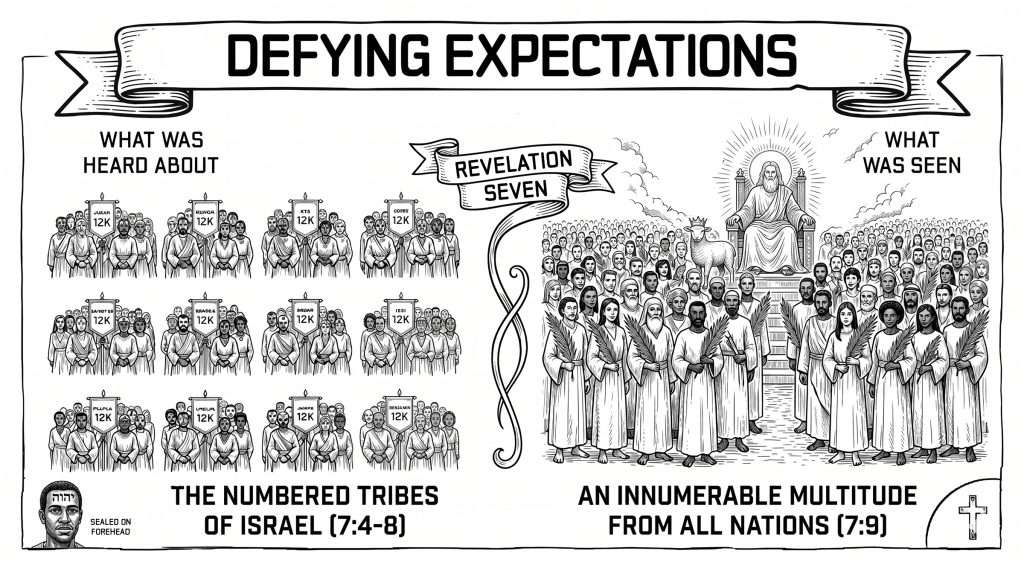
This represents another of several instances in Revelation where John hears about something before he sees it. From the description, he hears we are given expectations for what will be seen, but then, when he looks, the sight that meets his eyes is very different from his expectations. This is similar to the instance where he heard a voice like a trumpet, but then turned and saw the Son of Man, or when he heard about the Lion of Judah, but then saw a slain lamb. Here he heard (vs. 4) the 144k’s numbers, but then saw an uncountable group. These and several others are a recurring theme of difference between what he hears about, and what he sees. (Revelation 1:10-13, 5:5-6, 11:3-11, 17:1-15, 19:11-13, 21:9-10).
This phenomenon has led some Bible teachers to assume, then, that the 144k and the unnumbered multitude must be one and the same. However, this creates a logical challenge. Not only is one group numbered and the other not, but the first comes from the tribes of Israel (vs. 4-8), and the other seems to include predominately gentiles, since they are from every nation and all tribes and peoples and tongues (vs. 9). This has led some to speculate that the 144k are not actually Jewish, but that isn’t supported by the text either.
It seems more likely that the 144,000 and the innumerable multitude have a joint identity, but are not identical in the way we might assume. Because Revelation later refers to the 144,000 as "first fruits" (Revelation 14:4), some Bible teachers suggest they act as Jewish evangelists during the tribulation, with the uncountable multitude serving as the resulting harvest of their ministry. While this beautifully aligns with the biblical first fruits motif, it does go beyond what is strictly stated in the text. Whether their connection is a literal sequence of evangelism or something more symbolic, the pairing serves to highlight a profound contrast between Old Testament expectation and New Testament fulfillment. First-century Israel expected the Messiah to be a warrior king who would overthrow their enemies through a violent, militaristic conquest. This expectation is exactly what John hears: a tribal census mirroring the ancient Israelite muster rolls where men were counted for war (Numbers 1:2-3). John hears the roll call for a holy army (Revelation 7:4-8). Yet, when he turns to look, he sees the New Testament fulfillment: Jesus does not conquer the world through military force, but by redeeming it man by man. The result is not an exclusive Israelite battalion, but an uncountable, multi-ethnic multitude from every nation, saved by the blood of the Lamb, standing in victory before the throne (Revelation 7:9).
They are standing before the throne and the Lamb, clothed in white robes—a detail we’ve seen before in Revelation associated with overcomers, faithful believers (3:5). They’re also holding palm branches, a symbol often associated with victory and celebration.
Some Bible teachers who believe the rapture will occur sometime after the mid-point of the tribulation, but before the worst of the final judgments, think this verse is a reference to the rapture (1 Thessalonians 4:16-17, 1 Corinthians 15:51-52). Whether this represents the rapture event, we don’t know. What we do know is that it is a glorious occasion.
and they cry out with a loud voice, saying, “Salvation to our God who sits on the throne, and to the Lamb.” And all the angels were standing around the throne and around the elders and the four living creatures; and they fell on their faces before the throne and worshiped God, saying, “Amen, blessing and glory and wisdom and thanksgiving and honor and power and might, be to our God forever and ever. Amen.” (Revelation 7:10–12)
This is a sweet moment of worship. It’s often the case that the most powerful moments of worship come after tremendous struggle and pain. Likely, John was standing there wondering who these millions of people were, and he didn’t have to wonder long. The scene then shifts slightly as one of the elders addresses John directly:
Then one of the elders answered, saying to me, “These who are clothed in the white robes, who are they, and where have they come from?” (Revelation 7:13)
This interaction is significant because it marks one of the few moments in Revelation where John has a direct conversation within his vision. The elder steps away from worship to ensure John understands what he is seeing.
I said to him, “My lord, you know.” And he said to me, “These are the ones who come out of the great tribulation, and they have washed their robes and made them white in the blood of the Lamb. (Revelation 7:14)
Earlier in Revelation six, we saw martyrs who seemed to represent believers throughout history, but this group is distinct. They are those who have specifically come out of the Great Tribulation. They are believers because they have been made right with God through faith in Christ, but white robes are specifically associated with overcomers (Revelation 3:5). Notice the active phrasing here: it is the believers who wash their robes in the blood of the Lamb. While Christ offers irrevocable salvation as a free gift to all who believe, this verse highlights the active discipleship and faithful endurance demonstrated by these believers during the tribulation. To hold a privileged place of reward in the coming kingdom, believers are called to a life of ongoing faithfulness—continually cleansing themselves through reliance on Christ’s sacrifice (1 John 1:9).
If we view the 144,000 as God's tribulation messengers, it’s reasonable to interpret this moment as the culmination of their mission. This vast harvest of believers, brought into the kingdom during this darkest hour, now stands before the throne of God. It represents God’s relentless effort to spread the gospel to the ends of the earth, ensuring the harvest is as plentiful as He desires. The Elder continues his explanation.
“For this reason, they are before the throne of God; and they serve Him day and night in His temple; and He who sits on the throne will spread His tabernacle over them. “They will hunger no longer, nor thirst anymore; nor will the sun beat down on them, nor any heat; (Revelation 7:15–16)
This verse highlights the intimacy and closeness these overcomers now enjoy with God. They are constantly in His presence, serving Him in His temple. The promise of God spreading His tabernacle over them emphasizes His protection and dwelling with them.
This imagery echoes themes found in one of King David’s songs of ascent, where he wrote, The LORD is your keeper; The LORD is your shade on your right hand. The sun will not smite you by day, Nor the moon by night. (Psalm 121:5–6) The Israelites sang this song of ascent as they traveled to Jerusalem for festivals and ultimately ascended the temple mount to worship God. That close association with proximity to God’s temple fits with the multitude’s role. For the Jewish mindset, to discover that this multitude of Gentiles would have such a closeness to God for eternity would be surprising.
for the Lamb in the center of the throne will be their shepherd, and will guide them to springs of the water of life; and God will wipe every tear from their eyes.” (Revelation 7:17)
This language is strikingly similar to the descriptions found at the very end of Revelation, where the eternal kingdom is described. The mention of wiping away tears and the water of life points ahead to the ultimate fulfillment of God’s promises when all things are made new.
It seems that this part of the vision provides a brief glimpse into what will come after the tribulation when Jesus returns to establish His eternal kingdom. However, the narrative will soon pull back to the present focus of the vision and return to the unfolding of the seventh seal.
The final verse of the sequence comes from the next chapter. We’ve seen the six seal judgments, followed by an interlude. During the interlude, 144k Israelites and an uncountable multitude of gentile overcomers have been redeemed from the tribulation. Now, we arrive at the seventh seal.
When the Lamb broke the seventh seal, there was silence in heaven for about half an hour. (Revelation 8:1)
Even standing silently for a few seconds feels awkward, doesn’t it? Imagine that—a moment of complete silence. After everything we’ve seen so far in Revelation—the tumult, the tribulation, the chaos unfolding on earth—suddenly, it’s quiet. Imagine the profound stillness in heaven.
One parallel is in the creation story. There, we see six days of activity followed by a day of rest. Similarly, this pattern of six judgments followed by a pause seems to echo that rhythm. This silence brings us to a point where Jesus’ return is imminent—just on the horizon.
If we were reading Revelation for the first time, we might assume the silence of the seventh seal is the exact moment of Christ’s return. But instead of the grand finale, we hit a structural crossroads. The text introduces more judgments. To explain why the Second Coming doesn't immediately happen here, readers generally adopt one of two frameworks: the Telescopic View or the Recapitulation View.
The first approach, the Telescopic View, attempts to read the judgments of Revelation strictly chronologically. Imagine a collapsible brass spyglass. In this view, the judgments don't merely follow one another; the seventh seal actually contains the entire next set of judgments. When the Lamb breaks the final seal, it extends outward like a telescope, revealing the seven trumpet judgments hidden inside it. This theory maintains a continuous, linear timeline, arguing that the events are always marching sequentially forward into the future.
The alternative approach is the Recapitulation View, which proposes that the narrative actually hits rewind. Rather than a straight, sequential timeline, this theory suggests John's vision cycles back to cover the exact same period of tribulation, just from a completely new vantage point. Think of it like watching an instant replay from a different camera angle—you are witnessing the same climactic timeline unfold, but with new details and escalating intensity. Proponents of this viewpoint out that this "recapitulation" happens several times throughout Revelation, layering the narrative and continually bringing the reader right up to the brink of the end before resetting the scene.
Whichever one is correct, there is no denying that what comes next will usher in wrath and judgment as the world has never seen before.