
The Tree of Life holds a significant place in Scripture, appearing at the beginning in Genesis and reemerging in the final chapters of Revelation. From the Biblical perspective which emphasizes that eternal life is a free gift received by faith alone in Christ alone, the Tree of Life represents both our physical and spiritual life, illustrating God's provision and the eternal life believers will fully experience in the future.
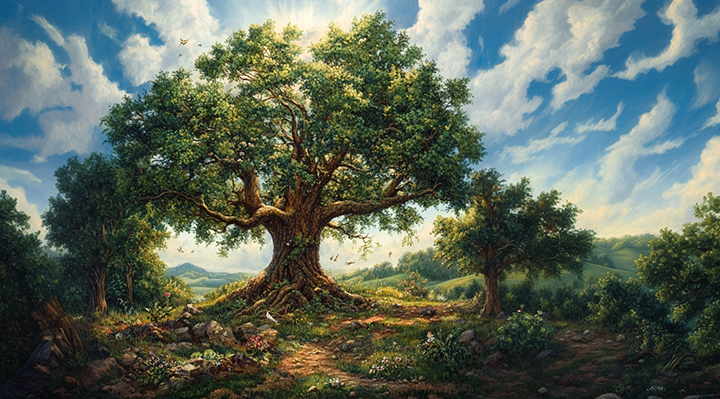
The Tree of Life first appears in the Garden of Eden, as described in Genesis 2:9:
“And out of the ground the LORD God made to spring up every tree that is pleasant to the sight and good for food. The tree of life was in the midst of the garden, and the tree of the knowledge of good and evil.”
The Tree of Life, positioned at the garden's center, demonstrated God's provision for humanity's physical and spiritual sustenance. However, after their disobedience and the Fall, God barred them from eating from the Tree of Life, as described in Genesis 3:22-24:
“Then the LORD God said, ‘Behold, the man has become like one of us in knowing good and evil. Now, lest he reach out his hand and take also of the tree of life and eat, and live forever—’ therefore the LORD God sent him out from the garden of Eden to work the ground from which he was taken. He drove out the man, and at the east of the garden of Eden he placed the cherubim and a flaming sword that turned every way to guard the way to the tree of life.”
This barring of access to the Tree of Life demonstrates the consequence of the original sin: separation from God and the forfeiture of gaining eternal life. Mankind is born into this fallen state. However, it is important to note that, through the work of Christ, believers have gained the promise of eternal life through belief in him. The loss of the intended fullness of life that God had planned for Adam and Eve along with all humanity has been overcome by His plan. He become a man, lived a perfect life, took on the punishment of sin for all mankind. And His gift—eternal life with God—is a gift that can never be lost, but the experiential aspects of that life can be diminished by sin.

The Tree of Life is also mentioned in the book of Proverbs, where it symbolizes the blessings of living according to God's wisdom. Proverbs 3:18 states,
“She [wisdom] is a tree of life to those who lay hold of her; those who hold her fast are called blessed.”
Here, the Tree of Life represents the life-giving benefits of wisdom, while eternal life is secured by faith alone, and the quality of one's spiritual life is enriched by living in accordance with God's principles.
Proverbs 11:30 further emphasizes this:
“The fruit of the righteous is a tree of life, and whoever captures souls is wise.”
The righteous life, which bears fruit in good works and wise living, is depicted as a tree of life, offering sustenance and blessing to others. This underscores the importance of discipleship and spiritual growth, which enhance the believer's experience of eternal life.

The final appearance of the Tree of Life is in the book of Revelation, where it is restored to its original purpose in the new creation. Revelation 2:7 promises,
“To him who overcomes I will grant to eat of the tree of life, which is in the paradise of God.”
This promise is given to believers, signifying the ultimate restoration of what was lost in Eden.
Revelation 22:1-2 provides a vivid picture of the Tree of Life in the New Jerusalem:
“Then the angel showed me the river of the water of life, bright as crystal, flowing from the throne of God and of the Lamb through the middle of the street of the city; also, on either side of the river, the tree of life with its twelve kinds of fruit, yielding its fruit each month. The leaves of the tree were for the healing of the nations.”
This passage illustrates the eternal life believers will enjoy in God's presence, with the Tree of Life symbolizing the abundant, ongoing provision of life in the new creation.
This future access to the Tree of Life emphasizes that eternal life is not just a quantity of time but also a quality of existence. It is a life that is fully realized in the presence of God, where the effects of sin are completely removed, and believers experience the fullness of God's blessings.
The Tree of Life is a profound demonstration of God's provision and the eternal life He offers to all who believe in Christ. While sin temporarily barred access to this life, it is ultimately restored through Christ, who secures eternal life for believers. The Tree of Life serves as a reminder that eternal life is both a present possession through faith and a future hope of experiencing the fullness of God's promises in the new creation.1


I wish that you had said: "This passage illustrates the eternal life faithful believers will enjoy in God's presence." Not all believers are overcomers in the manner described by Revelation and thus will not have access to its Tree of Life.
Rewards are promised to faithful believers who through discipleship pleased God. But the tree of life is offered to all believers who have overcome the world. Believing in Jesus makes us totally pure and clean in the eyes of God, making us over-comers. Yet we all have our failings here, such as Peter who denied Christ on the night he was betrayed. Yet he was forgiven and was an overcomer. I believe it is a positional thing that we receive when we believe.
“To him who overcomes I will grant to eat of the tree of life, which is in the paradise of God.”
This promise is given to believers, signifying the ultimate restoration of what was lost in Eden.
Revelation 22:1-2 provides a vivid picture of the Tree of Life in the New Jerusalem: