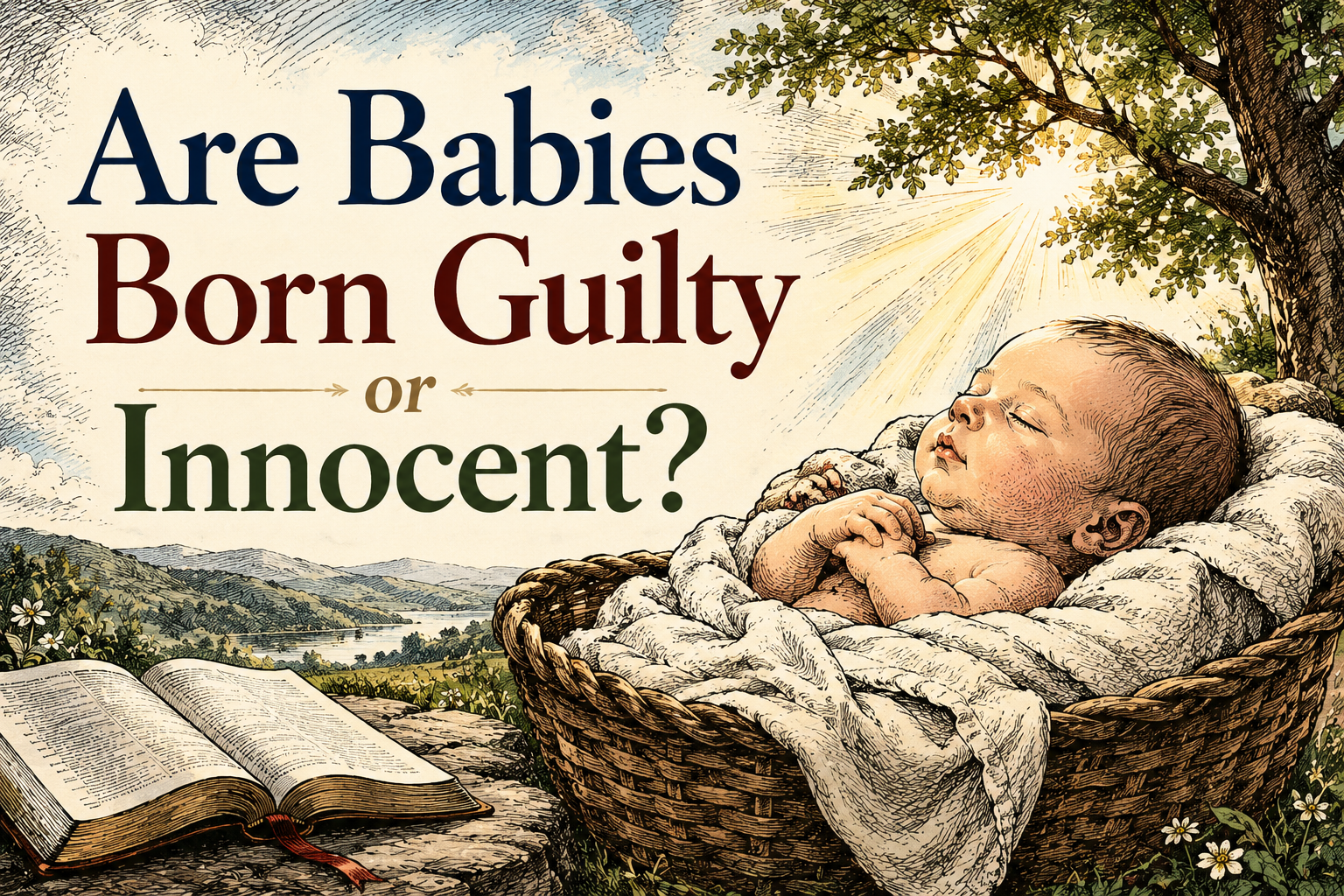


Q. Totally asking this in good faith. Augustinian theology aside, what Scripture supports that babies are born morally neutral and innocent? I know Pelagius says this, but the apostle Paul (and all councils and creeds) suggest the opposite
A. Great question! I don’t think Paul or the ecumenical councils teach that, though local Augustinian councils in the West did (if I remember correctly). And Augustinian-leaning theologians, including the Reformed, would follow in that error.
For the Patristic refutation of Augustine’s novel doctrine, I would point you to the Greek Orthodox theologian, Fr. John Romanides’s The Ancestral Sin. The East had a very different view of the matter, and, I think, a more Biblical one.
But you asked: “What scripture supports that babies are born morally neutral and innocent?”
That’s the right question. Just a reminder that the nature of sin is choosing to act against God’s law:
“Everyone who commits sin practices lawlessness; and sin is lawlessness” (1 John 3:4).
Or, more broadly, it is choosing to fail to do the good you know you should do:
“If anyone, then, knows the good they ought to do and doesn’t do it, it is sin for them” (James 4:17).
The key is that you must know the good to be responsible for doing it. That’s a common-sense principle, and a thoroughly Biblical one.
With that foundation laid, we know we all end up as morally depraved sinners, but that’s not where we began.
God creates each human spirit individually:
“The Lord, who stretches out the heavens, who lays the foundation of the earth, and who forms the human spirit within a person...” (Zechariah 12:1).
And He creates them upright. We’re the ones who choose to sin:
“I have discovered that God made people upright, but they pursued many schemes” (Ecclesiastes 7:29).
Hence, while babies are born with inherited mortal bodies, they are not born sinners but created upright, and remain upright until they choose to pursue their sinful schemes.
However, according to Scripture (not to mention common sense), a child needs to meet a minimum level of knowledge before he’s capable of genuine moral actions. And Scripture presents small children as not having that level of knowledge or culpability. For example:
“For before the boy knows to reject what is bad and choose what is good, the land of the two kings you dread will be abandoned” (Isaiah 7:16).
Isaiah assumes that children can be too young to know the difference between good and evil, a fact confirmed by Deuteronomy:
“Your children, who you said would be plunder, your sons who don’t yet know good from evil, will enter there. I will give them the land, and they will take possession of it” (Deuteronomy 1:39).
According to Moses, there’s a time when children are too young to “know good from evil.” In other words, it takes a minimal level of knowledge to be capable of responsible moral action. Young children are morally neutral. Paul confirms that point:
“For though her sons had not been born yet or done anything good or bad, so that God’s purpose according to election might stand” (Romans 9:11).
Paul refers to babies in the womb as not yet having done anything good or bad. In other words they were still innocent, or morally neutral.
In sum, babies are born mortal (thanks to Adam), but morally innocent. When their blood is shed, it is “innocent blood” (cf. Psalms 106:37-38; Jeremiah 19:4).
Children stay innocent until they eventually reach the point of being able to sin. And, tragically, every human being who has reached moral accountability since Adam and Eve have made that disastrous choice—everyone but Jesus, who never sinned. But children who die before being capable of moral action die in innocence. But just to clarify, a child who dies in innocence nevertheless still needs salvation from physical death (i.e., resurrection)—not to mention the impartation of righteousness, regeneration, eternal life, and dozens of other benefits that come from union with Christ.
For a longer survey of how sin actually works in the Bible to increasingly corrupt us mentally, spiritually, morally, and physically, you can read the first chapter of my book here:
__________________________________
Shawn Lazar (DPT, McMaster Divinity College) is the pastor of Gateway United Baptist Church in Denton, TX. Purchase his book One-Point Preaching here and his latest book Once Saved Always Saved? here.


Hey Shawn! Thanks so much for this article. really good stuff!
My question is in regards to this section of your article:
“ But just to clarify, a child who dies in innocence nevertheless still needs salvation from physical death (i.e., resurrection)—not to mention the impartation of righteousness, regeneration, eternal life, and dozens of other benefits that come from union with Christ.”
I am in total agreement with what you have written here! What you have written in the highlighted section has been a question I have pondered for a while now. How does a child who has innocence, but does not have the imputed righteousness of Christ (which comes by faith) come to be placed in Christ as a part of His body? In other words if resurrection, imputed righteousness, regeneration, eternal life, etc, do not come to that child by normal method of faith in the person of Jesus Christ during this physical life, then does scripture speak to how that innocent/morally neutral child receives those things?
I could just be totally missing it. Would love to hear any thought or further study you would suggest!
Thanks so much!
That's a great question, Micah. The right one to ask. But I don't think the Bible explicitly answers it. I have read many theologians say that babies automatically fall under the saving work of the atonement, but the evidence for that is, I think, a little fuzzy.
Personally, I can guess at how this MIGHT work, but this is the type of question that is answered less by having explicit information that gives us a precise solution, and more a matter of trusting the One who has the answer but hasn't revealed it to us. I don't think that is a cop-out. And I am happy to believe the answer whenever I see it clearly established from Scripture.
We are basically on the same page. I'm not sure the Bible asks whether a baby is 'innocent' or 'guilty', the baby is compromised in some sort of inclination to sin. But it is not until he or she reaches and age of reason and understanding that in every case that happens - they will choose evil and agree with Adam, our ancestral father, that rebellion against God is the better way. I never did buy Federal Headship view or even some lesser known views that still place Adam's guilt upon children.
"In sin my mother conceived me..." What do you do with sin nature? Are babies born with it? Not attacking at all, but curious.
I address that in my book. But in short, David is saying his mom was involved in something sinful in his conception. She is the sinner there, not him. If I say, "In anger did my father hit me," my dad would be the angry one, not me. There's Jewish tradition about what the sin in his conception might have been. It may explain why David was not thought about when the sons of Jesse were called by Samuel, or why David's siblings did not seem to like him.
Shawn, how do you reconcile this article with what many Free Grace teachers say—that unbelief is the only condemning sin? If infants are born innocent, what is the first sin that brings judicial condemnation before a person ever hears the gospel?
Thank you for the question.
"Shawn, how do you reconcile this article with what many Free Grace teachers say—that unbelief is the only condemning sin?" Well, I don't believe in that view. I'm not sure who originated it. Believers are forgiven of their sins and justified (see Romans 4). Unbelievers are not forgiven of their sins. Since the wages of sin is death, unbelievers are condemned already, and they will be judged according to their deeds (cf. John 3:18, 36; 5:28; Romans 2:6; Rev 20:12-13, etc). Jody Dillow treats this topic in chap. 59 of Final Destiny (he strongly disagreed with Zane Hodges's theory).
"If infants are born innocent, what is the first sin that brings judicial condemnation before a person ever hears the gospel?"
Since there are so many different kinds of sins of the mind, tongue, and behavior, there's no telling what a child who has reached the age of accountability will commit first.