Editor’s Note: Several years ago, Free Grace International published a blog post by Joe Conaghan arguing that eternal security is an essential part of the saving message. But Conaghan changed his mind and wanted to publish a retraction. Instead of posting a separate blog, I chose to include his recantation alongside the original, as an example of how it is normal for people to change their minds over time. We all need to be open to revising our beliefs in light of Scripture, better arguments, and evidence. This is an example of that. However, in publishing Conaghan’s recantation, I would also like to note that Free Grace International refuses to divide on this issue and is happy to cooperate with Free Grace authors and organizations who hold to different positions. While we believe in eternal security, we allow for a range of acceptable convictions on its place in coming to faith in Jesus Christ. ~Shawn Lazar
My doctor said that my symptoms indicated possible colon cancer, so he ordered the tests. I was fifty years old. Was this short ride really about to end so soon? Faced with an uncertain future, I wanted some assurance that I would go to heaven after I died.
For reasons I can’t explain, it entered my mind to call a childhood friend that I heard had become a pastor and with whom I hadn’t spoken since junior high school. I was afraid to even make the phone call. What if he told me something too difficult? I had to find out, so I called anyway. I’m so glad I did because Pastor Ryor walked me slowly and methodically through Ephesians 2:8-9, which reads, “For by grace you have been saved through faith, and that not of yourselves; it is the gift of God, not of works, lest anyone should boast.”
I had read these verses numerous times before, but until this phone call, I had never really heard them. “Joe,” he said after getting to the end of verse 9, “if you could do anything to earn salvation, you’d have a reason to boast. So it has to be a gift!” I was so excited and relieved to hear this that I started laughing because I couldn’t believe I had never heard this before in all my years among various denominations. He shared a few more things in relation to finding a good church and other matters that he indicated were separate from my salvation in Christ. Then Pastor Ryor prayed, and we said our farewells.[i]
That night we went out as a family to play Putt-Putt golf. I missed so many shots, even 2-foot putts. My daughter looked at me quizzically, “Why is he so happy? Does he not know he’s losing!?” The happiness I experienced that night was wonderful, and I’ve never forgotten it.
However, only a day later, this thought entered my mind: “Can I lose my salvation for any reason? I mean, is that a possibility?” My heart fell into my stomach. Now my hopeful outlook turned into uncertainty and my happiness into anxiety. This was too important to ignore, so I decided to discover the truth while praying to God for guidance.
Since Pastor Ryor was on the west coast and I was on the east, there was a local pastor that he asked me to reach out to after our phone call. I called him up, told him I had questions, and he agreed to meet me at a coffee shop in Centreville, VA. The meeting was enjoyable, the discussion was stimulating, and although my question on eternal security remained unsettled in my mind, I thanked the pastor for his time and the coffee, and we said our goodbyes.
As I was driving home, I was reminded of John 3:16. I quoted the words slowly: “For God so loved the world that He gave His only begotten Son,” and when I got to the second half of the verse, “that whoever believes in Him should not perish but have everlasting life,” I paused. Once more I replayed those words, “but have everlasting life.” Suddenly, the scales fell from my eyes, and I saw it. I yelled, “Irrevocable! That’s what “everlasting” means!”
I realized right then and there that my salvation was completely secure! I realized God, by His own words, was permanently stuck with me! As I pulled into the driveway, I knew everything had changed. I was finally utterly secure in my salvation by grace through faith in Jesus because God has promised in John 3:16 (and many other places) that the life He gives by believing in Jesus will never, ever be taken back.
It’s been seven years since my new birth in Christ, and I now have the benefit of examining the entire experience, one which I’ve come to understand is not that uncommon among born-again believers today, in light of what the Scriptures actually teach. The truth is that the gospel that Jesus preached was always clear on eternal security. He was not sent to offer anything else. Over and over and over again, He repeated the same promise, that anyone who believes in Him has everlasting life (John 3:15, 16, 36; 4:14; 5:24; 6:35, 37, 47; 10:28; 11:26; etc.) Not temporary life. Not probationary life. Eternal life. As the One who is from everlasting to everlasting, it should not surprise us that He only offers this type of life.
So why, you may ask, do so many confess to similar experiences of not being clear on the eternal security of the believer until weeks, months, or maybe years after first placing their faith in Christ? Well, it’s simple really. In most cases, I would submit that the reason is that the gospel being preached is not the one that forever saves.[ii] Rather, it is a “capless gospel.” That is, it leaves open-ended the question of eternal security, treating it as a peripheral issue when in fact it is the very nucleus of the atom of saving faith. Until we have been convinced that because we have believed in Jesus, we are secure, we are still working for our salvation. We’re still unsaved. Contrariwise, the moment we believe ourselves to be inextricably “trapped” in the mighty hand of God, with no possible way out, all inner striving comes to a screeching halt, and we are forever saved, ushering in a permanent peace that surpasses all understanding.
Let’s not proclaim a capless gospel. Eternal security should not be hidden when we share Christ. As ambassadors of Christ to a dying world, through the power of the indwelling Holy Spirit, let us make clear to each and every person that the only kind of life God offers them is His life that never ends. Let’s show people that the sin issue is done away with because Jesus paid it all on the cross and that once they have believed in the Lord Jesus Christ for the free gift of salvation, they are saved and saved forever, with no possibility of God rescinding the gift, as it is written, “For the gifts and calling of God are irrevocable” (Rom 11:29).
Let us always remember to put the cap on.
Several years ago I wrote an article titled “Everlasting Life Is the ‘Cap’ on the Gospel.” In it, I argued that eternal security must be included as an essential part of the saving message itself. I claimed that a gospel without the “cap” of eternal security is a “capless gospel,” and that understanding the irrevocability of eternal life is at the very nucleus of saving faith.
I now publicly recant that position. I was wrong.
I reject the man-made labels “Focused Free Grace” or “Flexible Free Grace.” Free Grace theology is correct. Salvation is by grace alone through faith alone in Christ alone, with no works required before, during, or after to keep it. However, I was mistaken to make a person’s understanding and affirmation of eternal security a requirement for regeneration.
While I still believe eternal security is a vital, glorious truth that greatly strengthens Christian assurance and is essential for healthy growth in Christ, it is not a requirement for a person to be genuinely saved. The truth of eternal security is implicitly present in the gospel (as the “germ” in the promise of everlasting life), but it is not the explicit object of saving faith. The Scriptures present the gospel more simply than I made it.
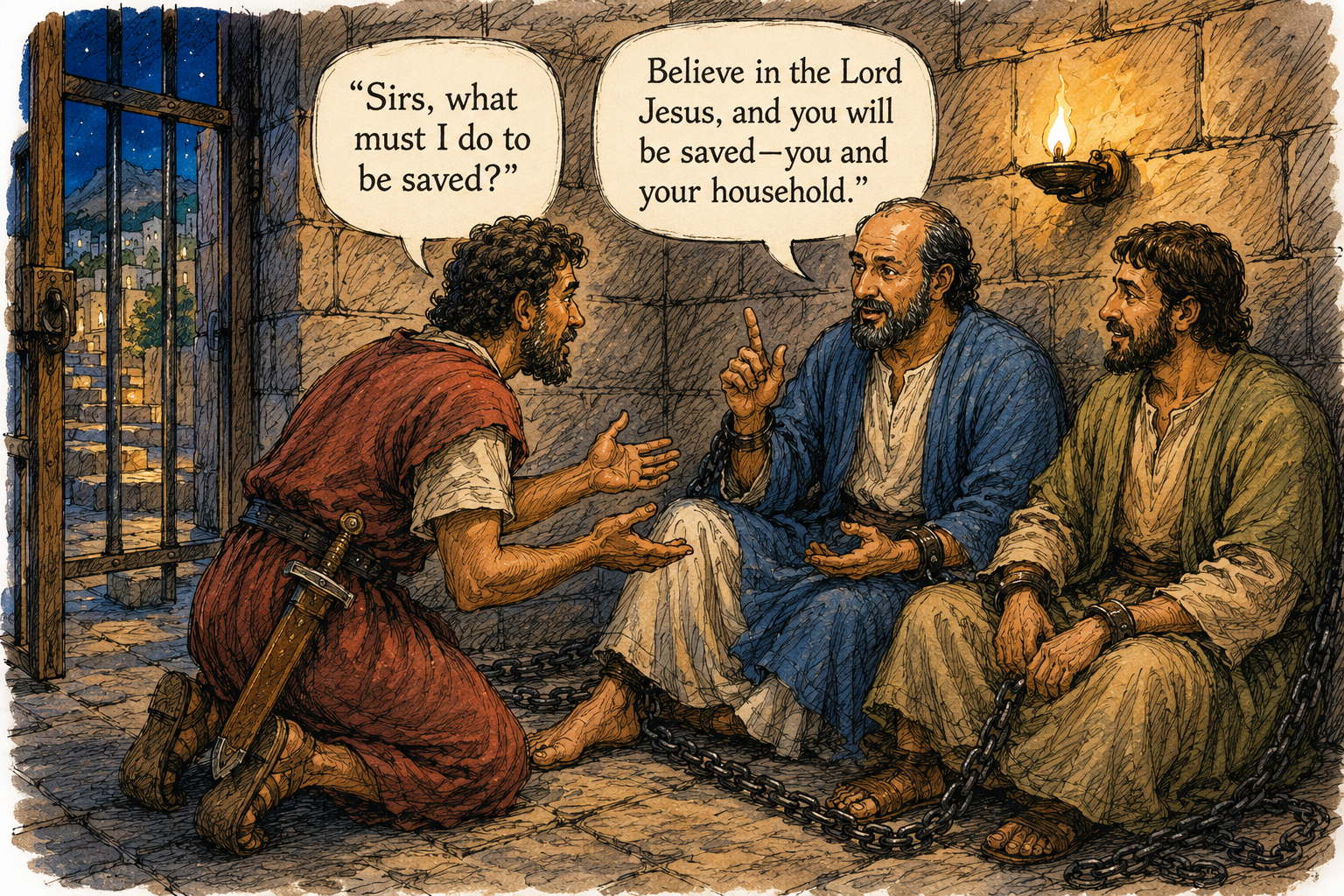
When we examine the actual gospel presentations in the New Testament — whether from Peter, Paul, or others — we never find them making the irrevocability of eternal life the explicit object that the sinner must understand and believe in order to be saved. They simply called people to believe in the Lord Jesus Christ and what He had done.
Consider these clear examples:
In each of these cases, and throughout the New Testament gospel proclamations, the call remains consistent and straightforward. We should trust the Word of God as it stands and leave the work of illumination and conviction to the Holy Spirit. The Scriptures are more than sufficient to accomplish God’s saving purposes in those who hear them.
In that earlier article I shared how Chuck Ryor witnessed to me in the Chick-fil-A parking lot, walking me through Ephesians 2:8-9. I believed the gospel that day and was saved. A few nights later my assurance was severely challenged. During that struggle, I came to a deeper understanding of the word “eternal” in John 3:16.
That later experience did not save me. It fortified and strengthened the assurance I had already received when I believed the simple gospel in the parking lot. I framed my testimony in the article in a way that implied the John 3:16 moment was when I was truly saved. That was inaccurate. I was already born again the moment I trusted Christ through Ephesians 2:8-9.
I was wrong to elevate a right understanding of eternal security to the level of a requirement for regeneration. Even though I remain convinced that a rejection of eternal security is a serious red flag — often indicating a person is trusting in their own works rather than in Christ alone — this does not justify adding an extra doctrinal test that the apostles themselves did not require in their gospel preaching.
Free Grace theology is correct. Salvation is entirely by grace through faith in Christ’s finished work. I continue to love and teach the doctrine of eternal security because it is a precious biblical truth that brings deep assurance and is vital for Christian maturity. But there is a clear distinction between:
To everyone who read my earlier article, or who was influenced by my teaching: I am sorry. If my words caused you confusion, unnecessary doubt about your salvation, or added a burden the gospel does not carry, please forgive me.
The gospel really is simple. Believe on the Lord Jesus Christ and you will be saved — the moment you believe.
Joe Conaghan works in the software industry.


I can totally relate to Mr. Conaghan's statement from his article "Everlasting Life is the 'Cap' on the Gospel" when he said,
"I had read these verses [Ephesians 2:8-9] numerous times before, but until this phone call, I had never really heard them. 'Joe,' [the pastor] said after getting to the end of verse 9, 'if you could do anything to earn salvation, you'd have a reason to boast. So it has to be a gift!' I was so excited and relieved to hear this that I started laughing because I couldn't believe I had never heard this before in all my years among various denominations."
That last part of Mr. Conaghan's statement about how he "had never heard" that eternal life is a free gift is, it seems, the unfortunate reality of many in modern-day Christendom. And that's why I like to ask people, "Has anyone ever told you that eternal life is a free gift?" That question is not original with me; another Free Grace brother in Christ is where I got that from, and ultimately that is what the Bible teaches. So ultimately that thought is straight from the Bible. And that's why it's so surprising that most people — even most church people — have never realized that before! At least that has been my experience when I talk to people about it: they tell me that no one has ever told them that before! I encourage anyone reading this to consider whether that has also been what you've noticed or experienced. Because I'm guessing you will find the same thing that I have, which is that most people have never realized or stopped to consider that eternal life is indeed a free gift! As the Bible says, "but the free gift of God is eternal life in Christ Jesus our Lord" (Rom. 6:23, ESV).
As to Mr. Conaghan's "Recantation" article, I think it's wonderful to see that he's come too a greater understanding of the gospel and how it relates to the truth of eternal security. Namely, that although the doctrine of eternal security is vastly important it is not explicitly part of the content of saving faith (the gospel). I like to explain it like this: the heart of the gospel is that "Christ died for our sins" (1 Cor. 15:3). By implication that means "all" our sins because the text doesn't specify otherwise — and elsewhere the Bible explicitly teaches that Christ did indeed die for "all" our sins (e.g., see Acts 13:38-39). Therefore, if Christ died to pay for all our sins, then there is no sin that we could ever commit that would cause us to lose our salvation because there is no sin that Christ didn't already pay for. Our sin debt has been "paid in full" (Jn. 19:30, Greek tetelestai). So that is the meaning of what the apostle Paul says in 1 Corinthians 15:3 that "Christ died for our sins according to the Scriptures". So eternal security is not explicitly stated in the gospel, is my point. Rather, it is the next logical step or a deduction based on the fact that since Christ did die for all our sins, then there is no sin left out that we could ever commit that would not already be paid for and thus no sin that we could ever commit that would keep us out of heaven. Praise the Lord! But that fact, while absolutely true, is not explicitly part of the content of the gospel nor the content of saving faith. (For more information see my blog post article "Is Assurance the 'Sine Qua Non' of Saving Faith?") So I agree with Mr. Conaghan's "Recantation" of his earlier statements about eternal security. While eternal security is absolutely true, it is "never...the explicit object that the sinner must understand and believe in order to be saved." I agree. And I appreciate Mr. Conaghan's testimony in his "Recantation" article where he clarifies the gospel message and his greater understanding of it. Thank you and God bless!
This article is brilliantly and accurately done. It is one of the clearest expressions of the gospel (the good news of eternal life) I have ever read. Excellent job!