
Nineveh, was an ancient Assyrian city of Upper Mesopotamia, located in the modern-day city of Mosul in northern Iraq. It is located on the eastern bank of the Tigris River and was the capital and largest city of the Neo-Assyrian Empire, as well as the largest city in the world for several decades. Today, it is a common name for the half of Mosul that lies on the eastern bank of the Tigris river.
During an archeological dig led by Colonel Robert Taylor in 1830 at Nineveh, an ancient artifact was discovered. It lists the annals of Sennacherib, king of Assyria including his battles involving Jerusalem, and king Hezekiah of Judah. The artifact was called a prism because of its unusual shape. The prism contains six paragraphs of cuneiform written in Akkadian. They are hexagonal in shape, made of red baked clay, and stand 38.0 cm high by 14.0 cm wide. They were created during the reign of Sennacherib in 689 BC.
The Sennacherib Prism, Image Courtesy of David Castor
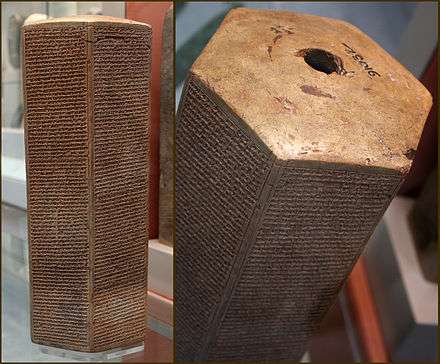
The Taylor Prism from the Neo-Assyrian empire tells the story of king Sennacherib's third campaign and includes descriptions of his conquests in Judah, some of which are described from another point of view in the Old Testament of the Bible. Isaiah, II Chronicles, and II Kings, all contain passages listing king Sennacherib's sieges in over forty cities of Judah and Israel.

From the British Museum's Guide to Babylonian and Assyrian antiquities, 1900, Public Domain, https://commons.wikimedia.org
One section of inscribed cuneiform describes Jerusalem as "his royal city" referring to the current reigning monarch, king Hezekiah of Judah.

It is one of three accounts discovered so far which have been left by Sennacherib of his campaign against the Kingdom of Israel and Kingdom of Judah, giving another perspective on these events from that of the books of II Kings, II Chronicles and Isaiah in the Bible.
Some passages in the Old Testament (II Kings 18-19) agree with the claims made on the prism. The Bible recounts a successful Assyrian attack on Samaria, as a result of which the population was deported, and later recounts that an attack on Lachish was ended by Hezekiah suing for peace, with Sennacherib demanding 300 talents of silver and 30 talents of gold, and Hezekiah giving him all the silver from his palace and from the Temple of Jerusalem including the gold from doors and doorposts of the temple.
Eliakim offering tribute of gold and silver from king Hezekiah to the Assyrian king Sennacherib

Compared to this, the Taylor Prism proclaims that 46 walled cities and innumerable smaller settlements were conquered by the Assyrians, with 200,150 people, and livestock, being deported, and the conquered territory being dispersed among the three kings of the Philistines instead of being given back. Additionally, the Prism says that Sennacherib’s siege resulted in Hezekiah being shut up in Jerusalem "like a caged bird," Hezekiah's mercenaries and 'Arabs' deserting him, and Hezekiah eventually buying off Sennacherib, having to give him jewels, ivory-inlaid furniture, his own harem, and musicians.
"As for the king of Judah, Hezekiah, who had not submitted to my authority, I besieged and captured forty-six of his fortified cities, along with many smaller towns, taken in battle with my battering rams. ... I took as plunder 200,150 people, both small and great, male and female, along with a great number of animals including horses, mules, donkeys, camels, oxen, and sheep. As for Hezekiah, I shut him up like a caged bird in his royal city of Jerusalem. I then constructed a series of fortresses around him, and I did not allow anyone to come out of the city gates. His towns which I captured I gave to Mitinti, king of Ashdod; Padi, ruler of Ekron; and Silli-bel, king of Gaza."
From the prism of Sennacherib
King Hezekiah resists the seige of king Sennacherib.
The tribute given by Hezekiah is then mentioned but in this account, nothing is said of Sennacherib capturing the city of Jerusalem. This adds weight to the Biblical account of God's promise through the prophet Isaiah that God would protect Hezekiah and Jerusalem at that time. (II Kings 19:33)
"By the way that he came, he will return; he will not enter the city, declares the LORD"
And he didn't. Sennacherib brags in the prism that "He shut up Hezekiah like a caged bird," his way of saying he couldn't get into the city.
Examples such as these should give us great confidence in the truth and reliability of the scriptures. As we read passages from the Old Testament, we can be assured that God has protected His Word over the centuries for our sakes, and wants us to learn about the truth of our history. 1
"As iron sharpens iron, so one sharpens another,"
Proverbs 25:17


