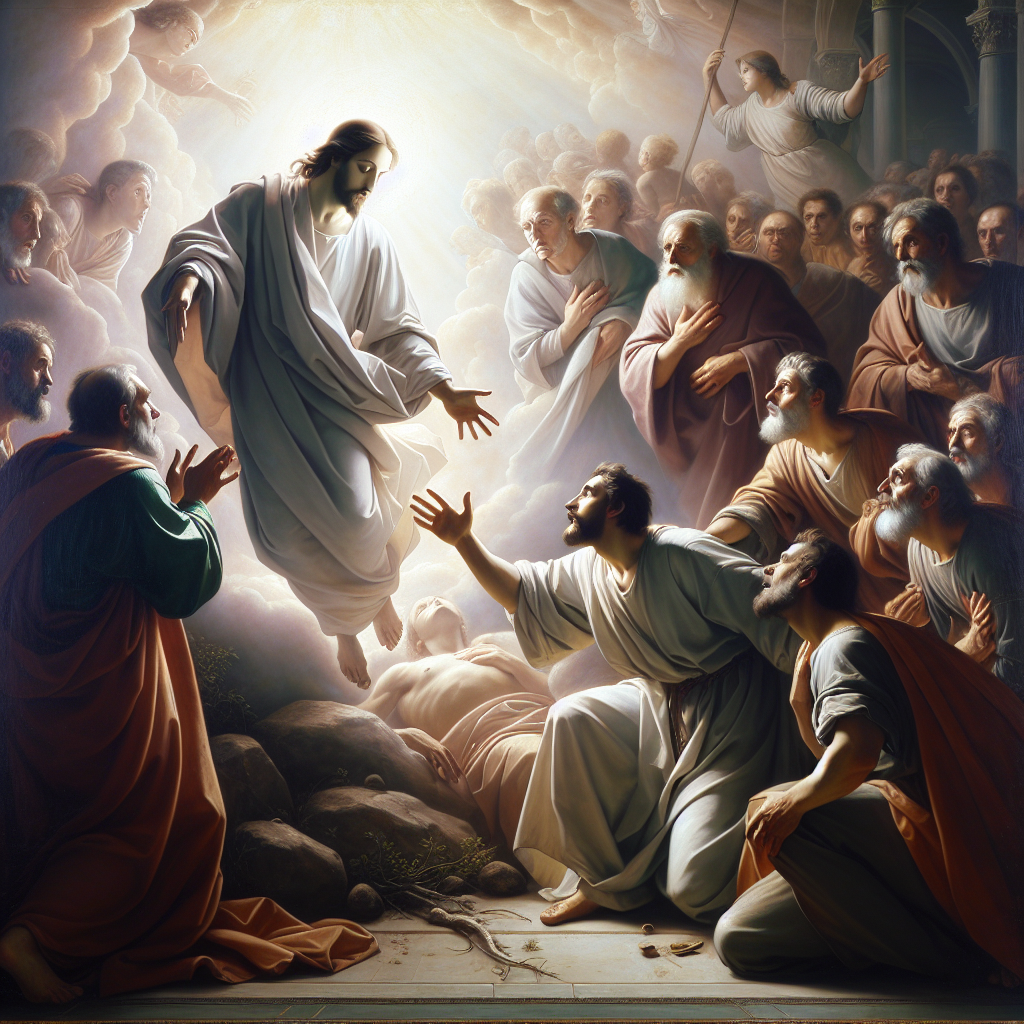
The story of "Doubting Thomas" is often misunderstood, but it presents a powerful lesson about faith, doubt, and the importance of seeking truth. This excerpt from Lucas Kitchen's book "Thomas" delves into Thomas's insistence on physical proof of Jesus's resurrection and challenges the common criticism leveled against him. It reminds us that honest doubt, when pursued with a sincere desire for truth, can lead to a deeper and more authentic faith. As you read, consider the courage it takes to stand apart from the crowd and demand evidence, even when surrounded by believers.
The ten disciples who saw Jesus living and breathing have just explained their experience to Thomas. Facing down ten convinced men Thomas says these bold words. So he said to them, “Unless I see in His hands the print of the nails, and put my finger into the print of the nails, and put my hand into His side, I will not believe.” 1 Here, he lays out the evidence that he needs to see in order to be convinced. He’s made his hypothesis and wants to run the experiment. Thomas’ refusal to believe is expressed using the double negative (ou mē), showing he was adamant about this matter. 2
His adamant demand is rounded out by what it is that he desires. He wishes to believe. The word “believe” has the sense of “persuasion” or to “think to be true.” 3 There need not be some esoteric or ethereal meaning attached to the word. The conviction that he sought was not one of an abstract philosophical idea, but of concrete truth. He wanted to know whether or not Jesus had raised from the dead. As he’s considering these things there is a load of peer-pressure on him. The others seem to expect him to bend to their expectations. They want him to admit belief in the resurrection as they had, yet they expect him to do so with only their word to serve as evidence, something they were previously unwilling to do. Even after they received the report from Mary, saw the empty tomb, and heard from those who met Jesus in Emmaus, they still didn’t believe. Despite the pressure, Thomas stands his ground and demands visual, and tactile evidence present in the body of Christ. If Christ is truly raised, this should not be a difficult request to fulfill.
Many have taken up the ten disciples cause and complained against Thomas' intentions here as if he should have believed without seeing. On this side of the debate, Matthew Henry wrote: He did not pay a just deference to the testimony of his fellow-disciples… He knew them to be honest men… Thomas, one of their own fraternity, would not allow them to be competent witnesses, nor trust them further than he could see them.” 4
Henry is not alone in his scathing review of Thomas’ conduct, but he holds an opinion that doesn’t make sense when taken to its logical end. Christ had called his apostles to be his witnesses. 5 The idea that one of the appointed apostles should be expected to accept such a pivotal assertion on the word of others alone is absurd. As Gary Burge puts it, “seeing” forms the basis of the apostolic witness. 6
Thomas was to be commissioned in the task of spreading the news about the risen Christ. If he did not see the proof with his own eyes, he would have been spreading hearsay and couldn’t be called a witness. Not directly witnessing the risen Jesus would have made Thomas’ ministry impossible. If he never witnessed the risen Christ he would be forced to admit that he had only been told by others that Christ rose. If he was to do the work that Jesus had called him to, he had no choice but to insist that he be allowed to witness the living Lord. An engineer must do his own calculations. A scientist must do his own experiments. An apostle must witness the risen Christ.
Twenty Centuries of men and woman have Thomas and the other disciples to thank for their ability to believe. Had they not been initially skeptical then we might have found it impossible to be convinced today. Not only are Thomas’ doubts fundamental to securing his future work, but they are completely natural. In fact, he was not alone in doubting; he is simply singled out because of a potentially serendipitous circumstance, his absence at the first post-resurrection advent. At first reading it looks like Thomas was more unbelieving than the other disciples, but this was not necessarily the case. 7
Although he carries the name of doubting Thomas, he was no more a doubter than the rest, since if he had been with them when Christ first appeared his doubts would have been removed at that point. 8 It is possible that Thomas believed that the disciples saw something of Christ, but he seems particularly interested in getting evidence of a physical nature. Some scholars have claimed that, "Thomas does not doubt that his friends think they saw something; he doubts only the nature of their experience." 9
To be sure, many skeptics have speculated that the disciples shared a hallucination to which their conviction was pinned. In this light, Thomas’ need for a second appearance becomes something of a safety net. The opponents of the faith might have been able to claim that the disciples were deceived if there had been only a single appearance of Christ for physical inspection. Because of Thomas' absence and need for proof, the ten disciples received not one opportunity but two, in which they closely investigated the body of Jesus.
What may be reasonably sure on a single investigation becomes an absolute certainty in the dried concrete of a second and third. 10 It was not only Thomas that may have needed this evidence alone since a second bodily appearance of Christ could only strengthen all the assurances of those involved. Though Thomas was the subject who solicited what follows, it is safe to say that the evidence Thomas received was for the benefit of all the apostles.
Thomas's story reminds us that it's okay to question, to seek evidence, and to demand truth. His initial doubt paved the way for a stronger faith, not just for him, but for believers throughout history.
This post is an excerpt from the book 'Thomas' by Lucas Kitchen. Get your copy of Thomas today.


Thanks for the teaching!