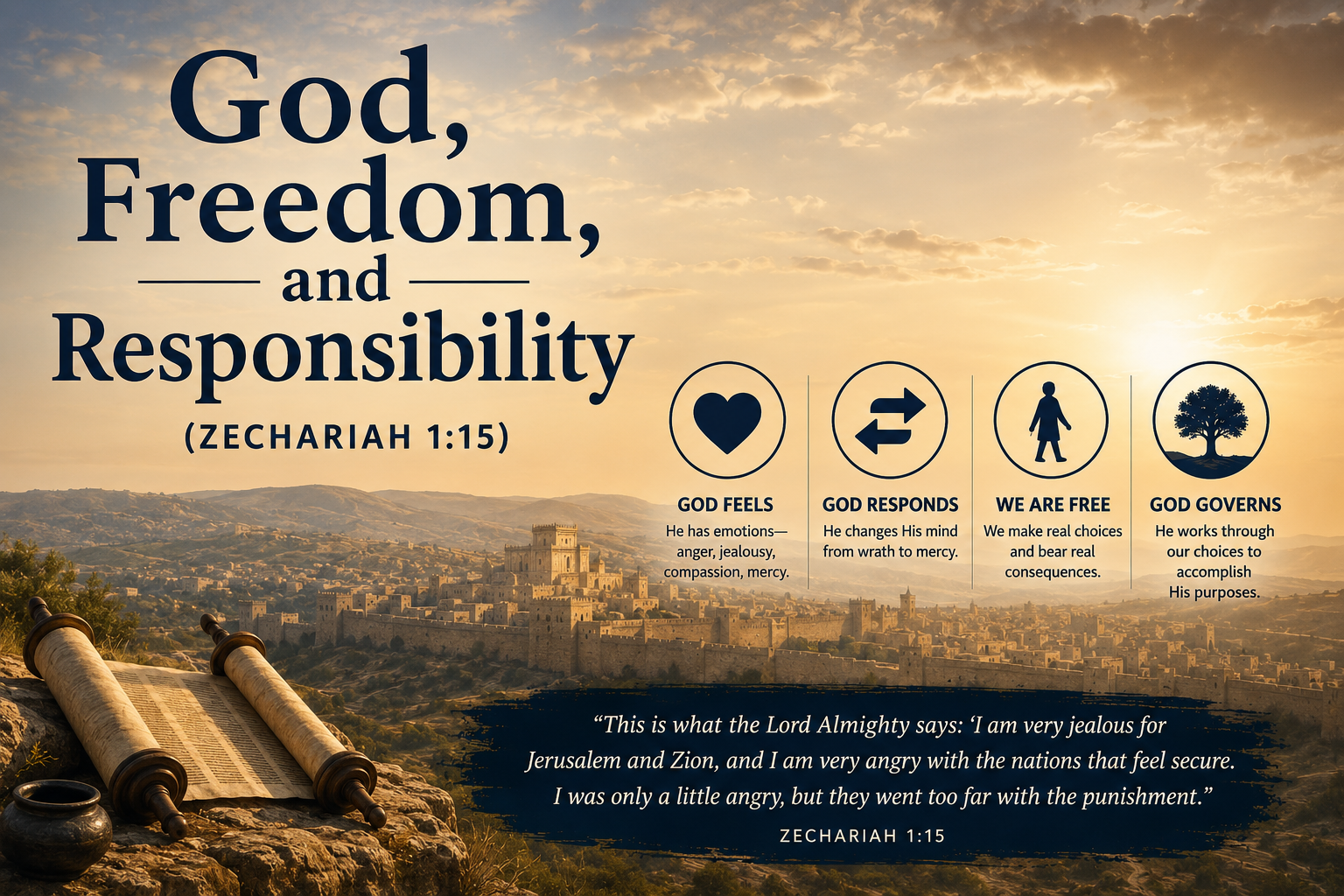


Then the angel of the Lord said, “Lord Almighty, how long will you withhold mercy from Jerusalem and from the towns of Judah, which you have been angry with these seventy years?” So the Lord spoke kind and comforting words to the angel who talked with me. Then the angel who was speaking to me said, “Proclaim this word: This is what the Lord Almighty says: ‘I am very jealous for Jerusalem and Zion, and I am very angry with the nations that feel secure. I was only a little angry, but they went too far with the punishment’” (Zechariah 1:12-15).
What is God really like? Is He like the abstract deity of the philosophers—a powerful but ultimately impersonal force that determines the course of all things—or is He a personal God who genuinely relates to the world?
In this short passage from Zechariah, we see strong hints that God is relational and personal, and we get glimpses of how He governs creation dynamically.
The context is that Israel had begun to return from exile, but was not yet prospering. Zechariah saw a vision and spoke to an angel. In this section, the angel of the Lord prays to the Lord about the fate of the nation.
Here are four lessons to draw from this passage.
First, God has emotions, such as anger and jealousy. He feels these in degrees (“I was only a little angry”). These are just a couple out of hundreds of references to God’s emotions in the Bible. Some people say such statements are just anthropomorphisms—they do not describe what God is literally like. But I think that view is difficult to maintain in light of the Incarnation. The Son of God became a man and felt emotions—He grieved and became angry. And Jesus reveals the Father to us. Given the Incarnation, I think it is impossible to deny that emotions are part of God’s life. Instead of God’s emotions being anthropomorphic, our emotions are theomorphic—reflecting God.
Second, God changes His mind. The prophet asks how long God will withhold mercy. The assumption is that God chose to withhold it and can change His mind and choose to show it again—which is what the Lord does here. How that works in eternity, if God exists outside of time, I cannot say. What I can say is that His mind toward Jerusalem changes from wrath to mercy.
Third, creatures have free will. Israel freely disobeyed God and suffered the consequences by going into exile. The Gentiles freely disobeyed God, and the Lord used them to take Israel into exile. But while God allowed the nations to do that, He did not approve of what they did. In fact, the Lord was angry that they took things too far. God says “they went too far with the punishment” (NIV), or “they made the disaster worse” (NRSV), or very literally, “and they assisted—for evil” (Young’s). God both allowed them to harm Israel and held them accountable for the evil they did.
Fourth, God’s providence is dynamic and responsive. He achieves His purposes in the world by working with the free choices of His creatures, in response to them, and not by controlling or causing them.
Far from depicting a static and unresponsive deity, Zechariah presents a God whose providence is personal, relational, and responsive—a God who loves, judges, relents, listens, and faithfully works not by eliminating creaturely freedom, but by wisely and sovereignly working through it.t’s all the more reason to do the most powerful thing any mother can do: pray without ceasing for her children.
__________________________________
Shawn Lazar (DPT, McMaster Divinity College) is the pastor of Gateway United Baptist Church in Denton, TX. Purchase his book One-Point Preaching here and his latest book Once Saved Always Saved? here.

