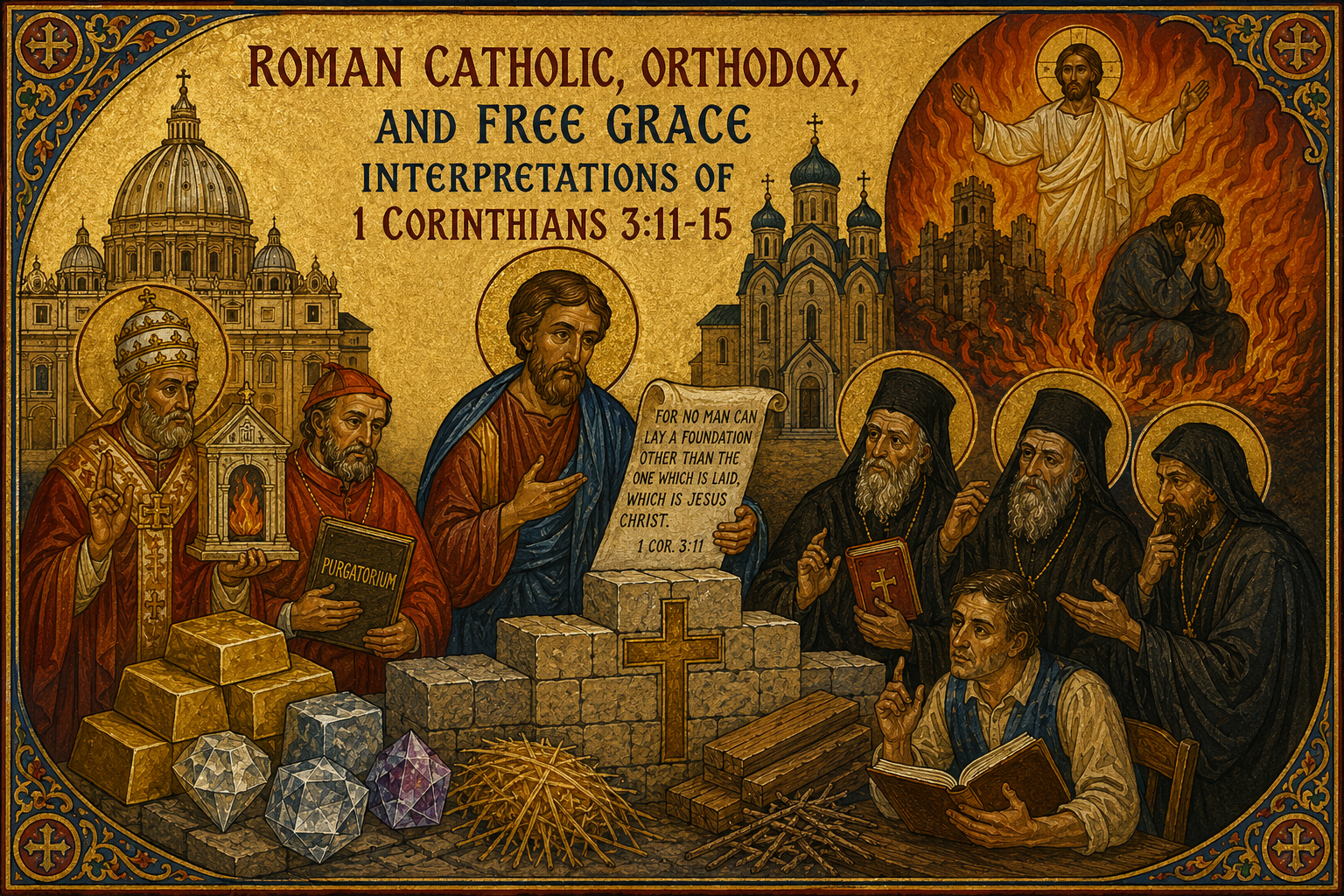


It may come as a surprise to you, but 1 Corinthians 3:11-15 changed the course of church history and of European history.
The Council of Florence, held between AD 1431 and 1445, was an attempt by the Roman Catholic and Eastern Orthodox churches to heal the schism between their communions. It began with a great deal of hope but quickly derailed.
One of the chief issues in dispute was the doctrine of Purgatory. And one of the chief verses that came up in the discussion of purgatory was something Paul wrote to the Corinthians:
For no man can lay a foundation other than the one which is laid, which is Jesus Christ. Now if any man builds on the foundation with gold, silver, precious stones, wood, hay, straw, each man’s work will become evident; for the day will show it because it is to be revealed with fire, and the fire itself will test the quality of each man’s work. If any man’s work which he has built on it remains, he will receive a reward. If any man’s work is burned up, he will suffer loss; but he himself will be saved, yet so as through fire (1 Corinthians 3:11-15).
As I was reading the history of this debate—as told from the perspective of Metropolitan Hierotheos, in his book Life After Death—I was truly shocked to read how the Orthodox interpreted Paul’s meaning. In this article, I will contrast the Roman Catholic, Orthodox, and Free Grace interpretations.
First, the Roman Catholics understood this judgment and “fire” to pertain to Christians. They read Paul as teaching that this fire would occur between death and the Last Judgment. And they understood it to mean that if necessary, the fires of Purgatory would purge Christians of sin, leading to their salvation. In other words, they took “saved through fire” to teach the doctrine of Purgatory.
Second, Metropolitan Hierotheos explains that there were at least three reasons why the Orthodox rejected this passage as evidence of a Purgatory. They noted the good works also passed through the fire, meaning this was a testing, not a purifying. Moreover, Paul describes people as suffering loss because of their works, which would not make sense if Purgatory were meant to lead to the attainment of salvation. Finally, they understood Paul as describing a judgment that will occur at the end of time, whereas, according to the Catholics, Purgatory is allegedly happening now (p. 177). Therefore, this passage was not proof of Purgatory.
So how did the Orthodox understand this passage? I was truly surprised by their interpretation. St. Mark of Ephesus, representing the Orthodox party, took Paul to be describing the judgment of the unsaved! The works that get burned up are sinful attributes such as “a bad disposition or action” and “the burdens of evil which sinners had” (p. 178). But even though the fires of judgment are burning up these sins, the lost will still be “saved” from being destroyed by this fire so that they can suffer eternally in hell! They are saved from being destroyed in hell, so they can be tormented instead. Yes, you read that right. St. John Chrysostom held to that view:
“for the sinner is saved as through fire,” that is to say he will remain tormented in fire and will not be destroyed together with his evil works and dispositions” (p. 178).
“They will inherit a salvation which is worse than perdition, remaining eternally in the fire (for this is what, strictly speaking, the word ‘saved’ means) lest they think that because of the destructiveness of the fire, they themselves will be utterly destroyed” (p. 179).
“Salvation” means going to hell? Frankly, that is one of the most counterintuitive interpretations of any Biblical passage I have ever come across. There is absolutely nothing in the context of that passage to suggest that Paul is describing how unbelievers are “saved” for hell.
To me, this is an example of why the Church Fathers are unreliable interpreters of Scripture.
So how should we understand Paul?
That brings me to the Free Grace view, which, I think, simply reflects what Paul actually writes.
Third, the Free Grace interpretation of this verse recognizes that Paul is describing believers, not unbelievers. We know these are believers because Paul is writing to the Corinthians, and at the top of the chapter, says he is addressing “brethen” who are “infants in Christ” (v 3). These are born-again believers, not unbelievers. And he says they have built on a foundation, namely, Jesus Christ. In other words, the issue is not whether these people believe in Jesus; they do. Paul’s concern is with the quality of their Christian life. Once you have been born again, you begin the life of discipleship, which is depicted as a building project. Every believer is a builder, whether they know it or not. The only question is what kind of materials you are using to build. Paul says if any man builds on the foundation with gold, silver, precious stones, wood, hay, straw, each man’s work will become evident; for the day will show. Ancient cities lacked modern firefighting services, so when a fire raged through a town, it did a huge amount of damage, burning up the cheaply made buildings and leaving behind those built of materials that could survive the fire. Similarly, on the day of this judgment, the quality of our works which we have done for the Lordwill be revealed with fire, and the fire itself will test the quality of each man’s work. If any man’s work which he has built on it remains, that is, if he used fire-proof gold, silver, and precious stones (i.e., heavenly treasure!), he will receive a reward. Paul clearly says this judgment is about the believer’s rewards.
Neither the Catholic nor the Orthodox interpretations address the passage’s central concern: eternal rewards. Frankly, that doctrine has been sorely lacking in church history, no doubt, due to the general neglect of Scripture in each of those traditions. Nevertheless, rewards are a prominent theme in the NT.
While Lord Jesus told us to believe in Him so as to have eternal life (cf. John 3:15-18), He also urged us to lay up treasure in heaven (cf. Matthew 6:19-24). And He wrote to the seven churches of Revelation about the rewards given to overcomers (cf. Revelation 2–3).
To put things all too briefly, the doctrine of eternal rewards reveals that while all believers will be in the kingdom, they can earn different levels of rewards in the next life. Overcomers can earn many different levels of rewards and treasures. But a believer who has been lazy or careless and has therefore “built” using cheap materials will have those works burned up by the fires of Jesus’ judgment. Instead of being rewarded, if any man’s work is burned up, he will suffer loss. That is, he will not be rewarded as he could have been. Instead of hearing the Lord’s approval (“Well done!”), he will hear His rebuke (“You lazy servant!”). Like the unprofitable servant in the parable of the minas, not only will he not be given any cities to rule over, but he will have his “money” taken from him and given to another. His experience of eternity will be less than it would have been had he worked to lay up treasure in heaven. He may be denied the other special rewards and privileges given to other saints. Still, as Paul says, even if someone were to have all their works burned up and suffer loss instead of reward, he himself will be saved, yet so as through fire. Salvation and rewards are distinct issues. Rewards are earned by faithfulness, but salvation is by grace, through faith, apart from works (cf. Ephesians 2:8-9). Hence, losing all rewards will not result in losing eternal life.
In my opinion, the Catholic and Orthodox interpretations of 1 Corinthians 3:11-15 are both off base because they do not follow the details of the passage. The Free Grace interpretation makes much more sense of the text as given. Don’t ever settle for traditions that do not follow the texts of Scripture—whether Roman Catholic, Orthodox, or even Free Grace.
__________________________________
Shawn Lazar (DPT, McMaster Divinity College) is the pastor of Gateway United Baptist Church in Denton, TX. Purchase his book One-Point Preaching here and his latest book Once Saved Always Saved? here.


Hi Shawn. I’m really blessed by your work. I’m a DTS grad but no longer a Calvinist. Can you direct me to some good material on John 17:2?
I am helping teach a Bible study and am not sure about the phrase “ all whom Thou has given Him”. It seems like it often refers to the apostles in the rest of chapter 17. Any input you have would be tremendously appreciated. Blessings to you. Susan
Good question! Jesus is praying for "all people" (or "all flesh"), so I think "those you have given to me" come out of everyone and is not restricted to the apostles. The big question is who does the Father give to Jesus? The simple answer is: believers. But does the Father give people to the Son before they believe (the Calvinist answer) or after they believe? I think it is after they believe. (1) God draws all people to Jesus, but that drawing is resistible. (2) When someone responds to the drawing in faith, (3) the Father gives them to the Son, and (4) the Son gives them eternal life.