Esther 2
2:1-4 Extra-Biblical documents suggest that between the events of chapters one and two, Ahasuerus traveled to Greece and waged war there for a few years. He was beaten badly in Grecian battles before he returned to Shushan, ready to take solace in the comfort his harem would supply. He was not long in the citadel at Shushan when his mind turned back to his former Queen. As he remembered Vashti, what she had done, and what had been decreed against her, he could think about her with no wrath or anger. It seems as if he was in a state of regret, possibly even missing her companionship.
Since having queen Vashti reinstated would spell danger for those advisors who had her deposed, they swooped in to remind the king of his plan to hold a nationwide beauty contest where young virgins would be sought for the king. The allure of having young, unmarried, attractive women paraded before him overcame the melancholy he felt over Vashti. He agreed to allow the one who pleases the king to be queen instead of Vashti.
2:5-7 Although we are not told his duty or role, Mordecai is in the citadel at Shushan. He apparently had a job working in the king’s gate (vv 2:19, 21, 3:2, 5:9, 13, 6:10, 12). The name Mordecai is derived from the Babylonian god Marduk's and Esther from the Persian goddess Ishtar's. Mordecai and Esther are cousins, though Mordecai adopted and raised her when she became an orphan (v 7). Both are the descendants of one of Jerusalem's houses of nobility. It was Nebuchadnezzar, the king of Babylon, who conquered and exiled the tribes of Judaea in 597 BC. The Babylonians had been conquered by the Medo-Persian Empire while the Jews were there in captivity. Although God had instructed his people to return to their homeland after seventy years (Is 48:20; Jer. 29:10; 50:8), it had been around one hundred and twenty, and Mordecai and Esther's family remained in their exile under pagan names. They were Jews incognito, though, behind closed doors, Esther apparently was known by her Jewish name (v 7). Their attempt to blend in could not hide the fact that this young, unmarried woman was lovely and beautiful.
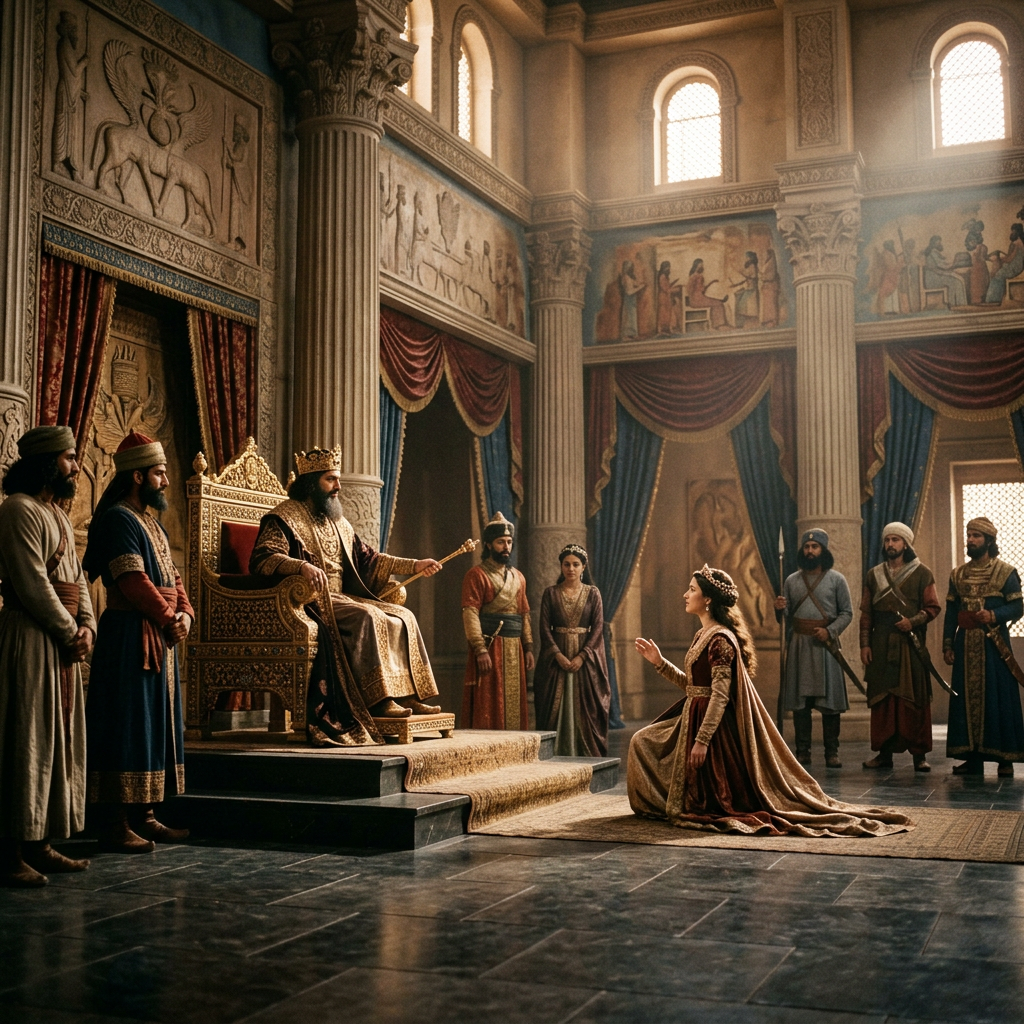
2:8-9 Esther was taken to the king’s palace, found favor with those who were in charge of the beauty content.
2:10-11 Esther was ethnically a Jew, but she was disobedient and unfaithful to God’s commands. She was preparing for a sexual encounter with a man who is not her husband which was forbidden by God (Exod 20:14), nor was she to marry a pagan (Deut 7:1-4). She ate food that did not meet the dietary laws (Lev 11:46-47), and she kept her religion a secret since Mordecai had charged her not to reveal it. Most likely, the only way a Jew could keep their religion a secret in a pagan society was to engage in pagan worship, at least at a nominal level. If she did, she would be violating a few of the ten commandments (Exod 20:3-4). Their family had not returned to their homeland as commanded by God (Is 48:20; Jer 29:10; 50:8). There is no mention of worshiping God, prayer, or even the mention of Yahweh in the book's entirety. Esther was a disobedient Jew.
Some might argue that she was under the king’s command and decree (v 8)and thus had no other choice but to comply. Yet, the prophet Daniel, whom she was probably aware of, had refused some of the same indiscretions under royal demand and pain of death (Dan 1:5, 8). Mordecai and Esther would have been seen by the original reading audience as unfaithful Jews who had arrived at a dissolution of their religious duties. The message of Esther, at least in part, is how God uses people both faithful and unfaithful for His own purposes.
2:11 It was unlawful for any Persian man, with the exception of eunuchs, to come within seven paces of a member of the king’s harem. Although, Mordecai kept more than seven paces away, it seems he may have been taking a risk by being anywhere nearby, but he took the risk to learn of Esther’s welfare.
2:12-16 Go in to the king is a polite way of saying she had sex with him. An entire year passed while Esther was waiting for her intimate date night with the King. There was a house for the “new,” concubines which Ahasuerus had never slept with before, and a second house for the “used” women who would never sleep with him again unless they were memorable enough to get a callback. Esther was more than simply memorable.
2:17-18 The king loved Esther.Love (“ʾāhab”) means much more than an erotic fancy, but describes the kinds of feelings one feels for a spouse, friends, and family members. It’s even used to describe the kind of love humans have for God and vice versa (Deut 4:37, 6:5). In his love for her, he made her queen instead of Vashti. Ironically, he made a great feast, again.He declared it a holiday and gave gifts. He was quite smitten with her. There is some ironic resemblance to Purim in this verse (see note on 9:20-32).
2:19-20 It would seem that making Esther Queen should have ended the acquisition of virgins. Apparently, king Ahasuerus intended to increase his harem, even though he was no longer looking for a new queen. Maybe because her position was not yet entirely stabilized, Esther continued to keep her religion and ethnicity a secret. She showed loyalty to Mordecai in that his influence was still apparent in her life.
2:21 Mordecai must have held an official role within the King’s palace for the access of its facilities he enjoyed (vv 2:5, 11, 19, 21, 3:2, 5:9, 13, 6:10, 12). As he sits at his official post, he overhears the makings of a conspiracy by two who sought to lay hands on King Ahasuerus. Mordecai passes the news through his royal insider, Esther, and she, in turn, mentions his name when she reports it to the king. Apparently, however she does not mention that she is related to him since that fact is revealed much later (8:1). The criminals are killed, and Mordecai's name is written down in the court records. Mordecai’s loyalty and quick action was a seemingly small detail, yet this event proved to be a pivotal plot point in God's plan.