Esther 6
6:1-3 Ahasuerus is not the first king whose sleep issues were used by God to preserve His chosen people (Gen 41, Dan 2). The amazing thing about God’s providence is that it is often so subtle that those who play a part don’t know they are doing so. A commonplace request to have the book of the records of the chronicles read aloud to him was another catalyst God would soon use to rescue his people from their imminent destruction. The reading reveals an occurrence that was a handful of years prior, where Mordecai quietly saved the king's life (2:21-22). King Ahasuerus wanted to know how Mordecai had been repaid for his loyalty. The servant said, “Nothing has been done for him.”
6:4-5 The king, it seems, rarely decided on his own but looked to his advisors for their guidance. He asked, “Who is in the court?” The irony of ironies, Haman was entering the court at that exact moment to ask permission to murder the same man the king wished to honor. In the classic art of grand storytelling, both parties think they know the mind of the other, and thus their conversation is gratifying for quirky reversal.
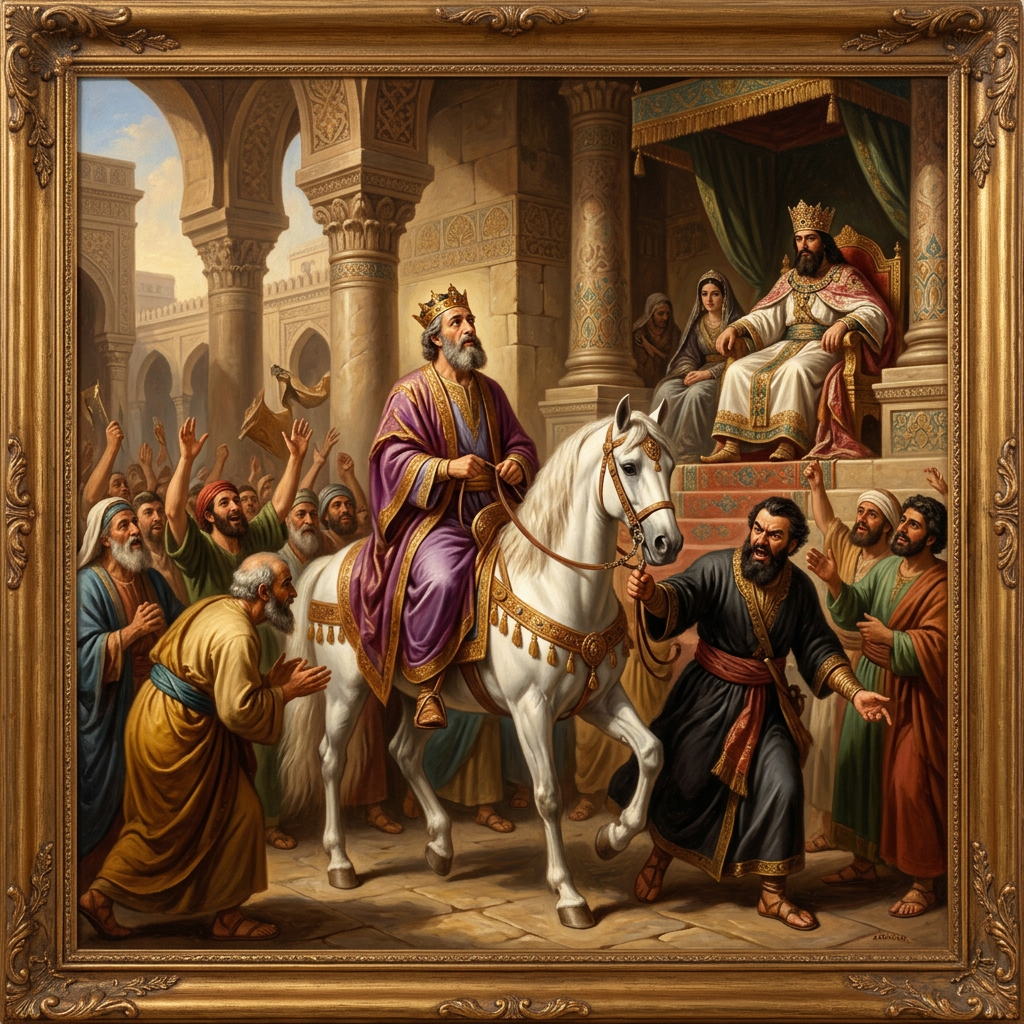
6:6-9 This is one of those places where it's acceptable to laugh at the Bible because the author intends there to be some ironic humor in the massive misunderstanding shared by the two most powerful men in the Persian kingdom. King Ahasuerus asked for Haman's opinion on how to best repay the man whom the king delights to honor? Haman’s blinding pride led him to ask inwardly, “Whom would the king delight to honor more than me?” This could be an apt representation of the proverb. Pride goes before destruction and a haughty spirit before a fall. (Prov 16:18) In response, Haman lays out the grandest royal procession, all the while imagining himself being the honored guest.
6:10 One can imagine how Haman’s face fell when he was finally let in on the true purpose of the king’s inquiries. It is interesting that the king called Mordecai by almost the same lengthy title, which Haman used as a derogatory slight (5:13). However, on the lips of the king, Mordecai, the Jew who sits within the king’s gate, was transformed into a title of honor and respect. Mordecai the Jew, would later become a kind of endearing folk title for this man of heroic deeds (6:10, 8:7, 9:29, 31, 10:3).
Haman had no choice but to obey the king’s orders, and what a humiliation it must have been. Is it possible that his words were less than enthusiastic when he cried out, Thus shall it be done to the man whom the king delights to honor? This amazing reversal is illustrated well by King David's words. You prepare a table before me in the presence of my enemies; You anoint my head with oil; My cup runs over. (Ps 23:5)
6:12-14 These verses tell of the difference in the character of these two men. Afterward, Mordecai went back to the king's gate, which is to say he went back to the humble place where he worked (4:6). Haman, on the other hand, hurried home, mourning and with his head covered. He hardly could endure the shame, and he had to return to the place where he hoped his closest allies would remind him of his greatness, which he had been bragging about only the night before (5:11). However, he did not receive the warm encouragement for which he hoped.
In the Persian culture, there was a constant watchfulness for omens and signs given by the gods. Though they were pagans, they could easily tell that something supernatural was going on. After hearing the morning's events, Haman's wife and wise men recognized the story was too uncanny to be a mere coincidence. This is one of the major themes of the book of Esther, and a lesson that can still be observed in the continued survival of the Jews, even today.
The bottom line of the book is well stated by Haman’s allies when they say, "If Mordecai before whom you have begun to fall, is of Jewish descent, you will not prevail against him but will surely fall before him." Their words, while probably not directly prophetic, are certainly predictive of God's often uncanny and unimaginable providence for those He has sworn to protect. Before Haman had a chance to respond, he was whisked away to Esther's second banquet, where he would face his last trial.

