Esther 7
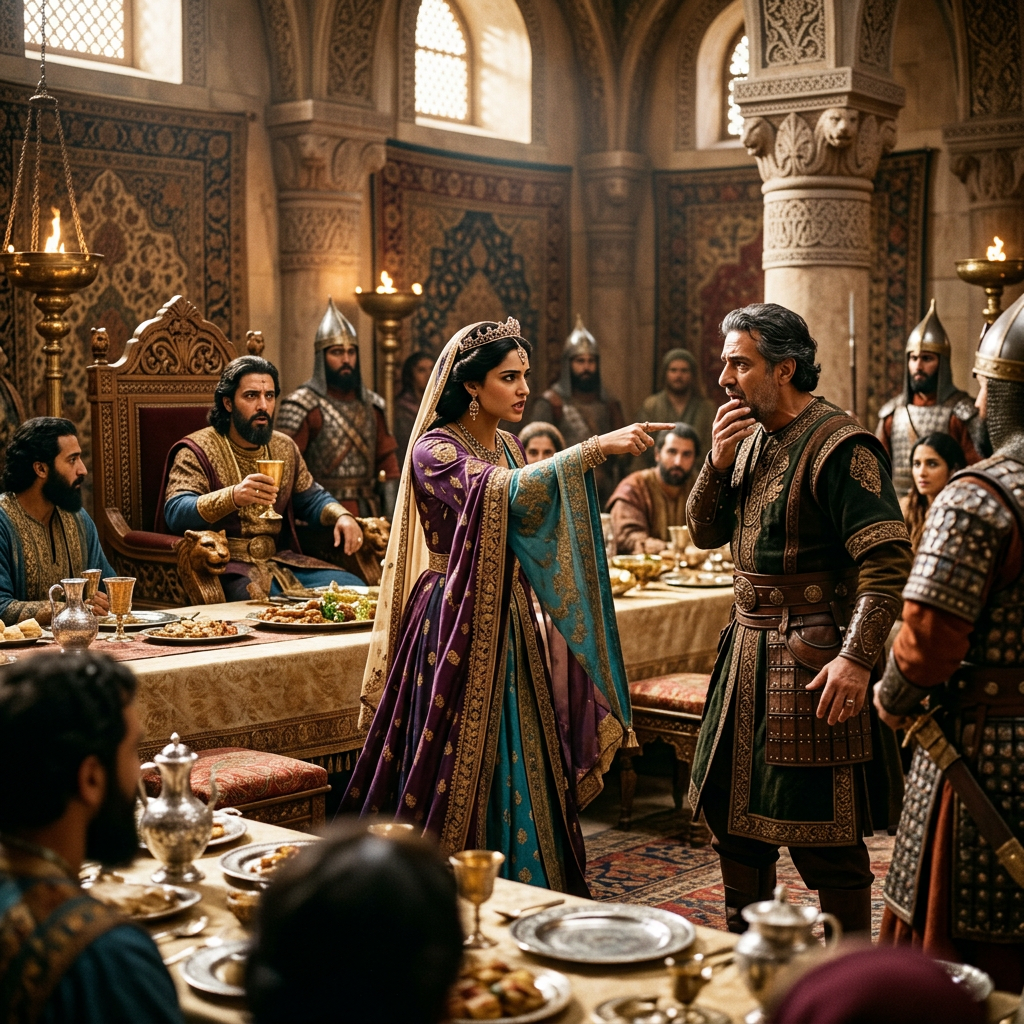
7:1-2 The moods of the three attendees of Esther’s dinner were varied. Haman had just come from a crushing humiliation (5:13). Ahasuerus had earlier that day honored Mordecai, who had saved his life years earlier (5:10) and likely was in good spirits. Esther knew that she was in strategic danger for what she was about to do. Once they came together, King Ahasuerus asked for the third time (5:3, 6) for Queen Esther to reveal her request, assuring her that even half the kingdom was not too much to ask.
7:3-5 In short, Esther’s request was for the king to spare her life and the lives of her people, the Jews. She explained the Jews had been sold, which was clearly a reference to Haman’s offer to finance the genocide of God’s people (3:9). A threefold outcome is predicted if the king chooses not to act. Esther and her people are to be destroyed, killed, and annihilated. She made it clear that this was no less than the utter end of an entire people group. However, what the king probably cared about even more, it would mean that for a second time, he would have to part with a queen whom he loved (2:1). Although the former may be something Ahasuerus could accept, Esther calculated the latter was not something the king could take.
The moment is significant for another reason as well. This is the instant Esther first revealed that she was a Jew (2:10) with statements like my people, and we. It was a huge but calculated risk, as she had already excepted the danger previously saying, if I perish, I perish (4:16). Her love for her people, who were spread throughout the kingdom, was so great that she was willing to lay down her life.
Haman had promised to fill the royal treasury with ten thousand talents of silver (3:9) in exchange for permission to kill all the Jews and to fund the genocidal project. Esther concluded her words by claiming that the enemy could never compensate for the king’s loss, both in the value of his Jewish slaves but also in the love he had for his queen. Even in this dire moment, Esther doesn't beg with illogical blubbering but offers an airtight fiscal argument against genocide. The king seems unaware of the situation Esther is discussing and asks who would dare presume in his heart to do such a thing?
7:6 Esther proved her amazing courage and grit when it came time to reveal the enemy. The story is filled with back-room decisions and behind-the-back stabbing attempts. Here Esther had the bravery to stand strong, face-to-face with her would-be killer and said, “The adversary and enemy is this wicked Haman!” Rightfully so, Haman was terrified.
7:7-8 The king was too overwrought with rage to reasonably respond. On hearing these new developments, and in his wrath, he arose, apparently saying nothing, and went into the palace garden. He faced a decisive moment. Haman had betrayed the royal queen, but he had also brought Ahasuerus into the ruse. The king was likely trying to calm down. While he was out, Haman remained behind to beg Esther for his life.
By the time the king returned, Haman had fallen across the couch where Esther was. It was illegal for any man to approach within seven steps of the royal harem or the queen. In Haman's desperate begging, he had violated a punishable law. The king came in to see Haman in close quarters with his wife and accused him of trying to assault the queen sexually.
At the suggestion of assault, the King’s guards apparently took swift and deadly action. The altercation is not described, but in the following moments, the enemy of the Jews was dead, indicated by the fact that they covered Haman’s face. It was traditional to cover the face of the dead in the ancient world.
7:9-10 Once Haman was dead, one of the servants told the king about the gallows, most likely an impaling pole, that Haman had constructed. They revealed that Haman had erected the spire to display the corpse of Mordecai, who spoke good on the king’s behalf. The king ordered that Haman be hanged upon the gallows. It was only at this point that the king’s wrath was satisfied.
God made a promise to Abraham and his descendants when he said, “I will bless those who bless you, and I will curse him who curses you.” (Gen 12:3) Haman, the greatest enemy of the Jews from that generation, stood as a divine example of God’s commitment to preserve and protect his chosen people.

