

How would you preach grace to prisoners?
Karl Barth (1886–1968) was a profoundly influential Swiss theologian. He became famous for standing up to Hitler during WWII at a time when so many German-speaking churches succumbed to Nazism. He was perhaps the most influential Protestant theologian since the Reformation, becoming a strong critic of “liberal theology.” Students from all over the world came to Basel to pursue their doctorates under him, and many more wrote their doctorates about him. Barth was—and is—a theologian’s theologian. Most average readers wouldn’t pick up his books. He’s too complicated. But a particular kind of pastor will. Frankly, his writing is mostly above my head, but I've read him since my undergraduate days, and I always learn something from him. Since becoming a pastor, I've gone back to reading him more.
You see, despite Barth’s influence in the academy, he strongly believed in both the church and preaching. Indeed, he thought that the whole purpose of theology was for preaching: “theology as a church discipline ought in all its branches to be nothing other than sermon preparation in the broadest sense” (Barth, Homiletics, p. 17).
Barth put that theory into practice. Despite his worldwide academic reputation, Barth preached to prisoners. Between 1954 and 1964, Barth held twenty-seven services in the Basel Penitentiary.
One of those sermons is called “Saved by Grace,” found in Deliverance to the Captives: Sermons and Prayers by Karl Barth. His text was from part of Ephesians 2:5, “it is by grace you have been saved.” I won’t reproduce the whole sermon here. However, he did repeat the phrase, “By grace you have been saved!” several times, and his comments following that refrain offer a good taste of what the sermon was about.
How do you preach grace to prisoners? Here is Barth—
By grace you have been saved!
“Whatever else we do, praying and singing, is but an answer to this word spoken to us by God himself. The prophets and apostles wrote a strange book, called the Bible, for the very purpose of testifying to this fact before mankind” (p. 36).
By grace you have been saved!
“No man can say this to himself. Neither can he say it to someone else. This can only be said by God to each one of us. It takes Jesus Christ to make this saying true. It takes the apostles to communicate it. And our gathering here as Christians is needed to spread it among us” (p. 37).
By grace you have been saved!
“Who are we, anyway? Let me tell you quite frankly: we are all together great sinners. Please understand me: I include myself. I stand ready to confess being the greatest sinner among you all; yet you may then not exclude yourself from the group!” (p. 37).
By grace you have been saved!
“To be saved does not just mean to be a little encouraged, a little comforted, a little relieved. It means to be pulled out like a log from a burning fire. You have been saved! We are not told: you may be saved sometimes, or a little bit. No, you have been saved, totally and for all time. You? Yes, we!” (p. 37).
By grace you have been saved!
“Look at Jesus Christ on the cross, accused, sentenced and punished instead of us! Do you know for whose sake he is hanging there? For our sake—because of our sin—sharing our captivity—burdened with our suffering! He nails our life to the cross. This is how God had to deal with us. From this darkness, he has saved us. He who is not shattered after hearing this news may not yet have grasped the word of God: By grace you have been saved!” (p. 38).
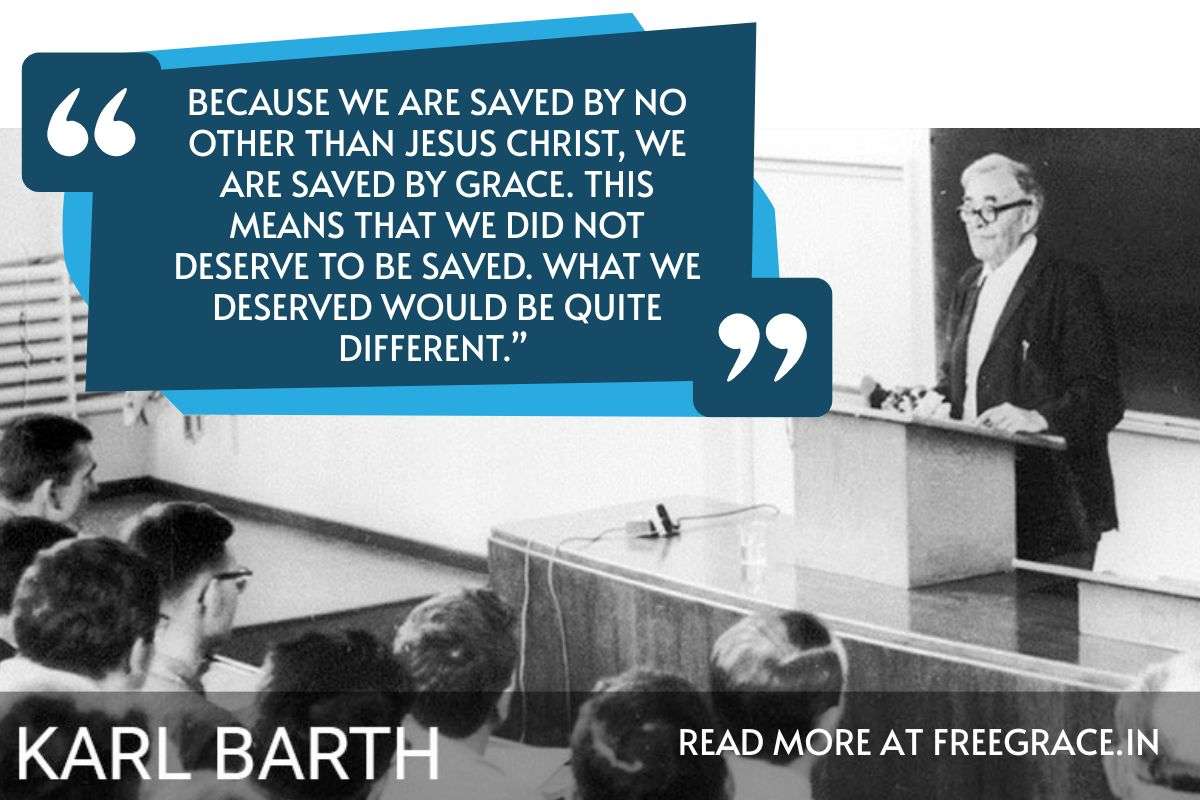
“Because we are saved by no other than Jesus Christ, we are saved by grace. This means that we did not deserve to be saved. What we deserved would be quite different. We cannot secure salvation for ourselves… No one can be proud of being saved. Each one can only fold his hands in great lowliness of heart and be thankful like a child. Consequently, we shall never possess salvation as our property. We may only receive it as a gift over and over again, with hands outstretched. ‘By grace you have been saved!’ This means constantly to look away from ourselves to God and to the man on the cross where this truth is revealed. This truth is ever anew to be believed and to be grasped by faith” (p. 39).
By grace you have been saved!
“—this is true, even though we may not believe it, may not accept it as valid for ourselves and unfortunately in so doing may forego its benefits. Why should we want to forgo the benefits? Why should we not want to believe? Why do we not go out through the open door? Why do we not open our clenched fists? Why do we obstruct our ears? Why are we blindfolded? Honest, why?” (p. 40).
By grace you have been saved.
“Ask that you may believe this and it will be given to you; seek this, and you will find it; knock on this door, and it will be opened to you” (p. 41).
_______________________
Send your questions or comments to shawn@freegrace.in.
Read his latest book, The Myth of Tithing and the Joy of Grace Giving by getting it from us or from Amazon.

