


Welcome to the Free Grace Bible Study, where today's episode takes us into the heart of the Book of Revelation, Revelation 1:1 through 8. The Revelation of Jesus Christ, is a message that transcends time, given to John for all of God's servants. Through today's passage, we explore the profound grace, peace, and impending return of our Lord, along with the promise of being kings and priests in His eternal kingdom.
<< PREV | NEXT >>
My daughter is nine years old, as of the time I’m writing this. She has recently discovered the enjoyment of writing letters. She has a cousin in another city to whom many letters have gone out. One characteristic of the letters my daughter writes is that the address is often hard to decipher. I noticed on one of the letters she received the zip code was incorrect, and yet the post office, in their amazing wisdom was still able to bring that letter to our mailbox. I'm pretty amazed at how well the post office does, considering how often seemingly vital information is left out of the address.
The book of Revelation is a letter, but its address is quite clear. John goes to great lengths to make sure there is not misunderstanding. He is much more clear than my daughter and her cousin are on who the letter is written to.
Jesus is coming,
so faithfully live
to get the reward
that He will give.
The Revelation of Jesus Christ, which God gave Him to show His servants—things which must shortly take place. And He sent and signified it by His angel to His servant John, who bore witness to the word of God, and to the testimony of Jesus Christ, to all things that he saw. Blessed is he who reads and those who hear the words of this prophecy, and keep those things which are written in it; for the time is near.
John, to the seven churches which are in Asia:
Grace to you and peace from Him who is and who was and who is to come, and from the seven Spirits who are before His throne, and from Jesus Christ, the faithful witness, the firstborn from the dead, and the ruler over the kings of the earth.
To Him who loved us and washed us from our sins in His own blood, and has made us kings and priests to His God and Father, to Him be glory and dominion forever and ever. Amen.
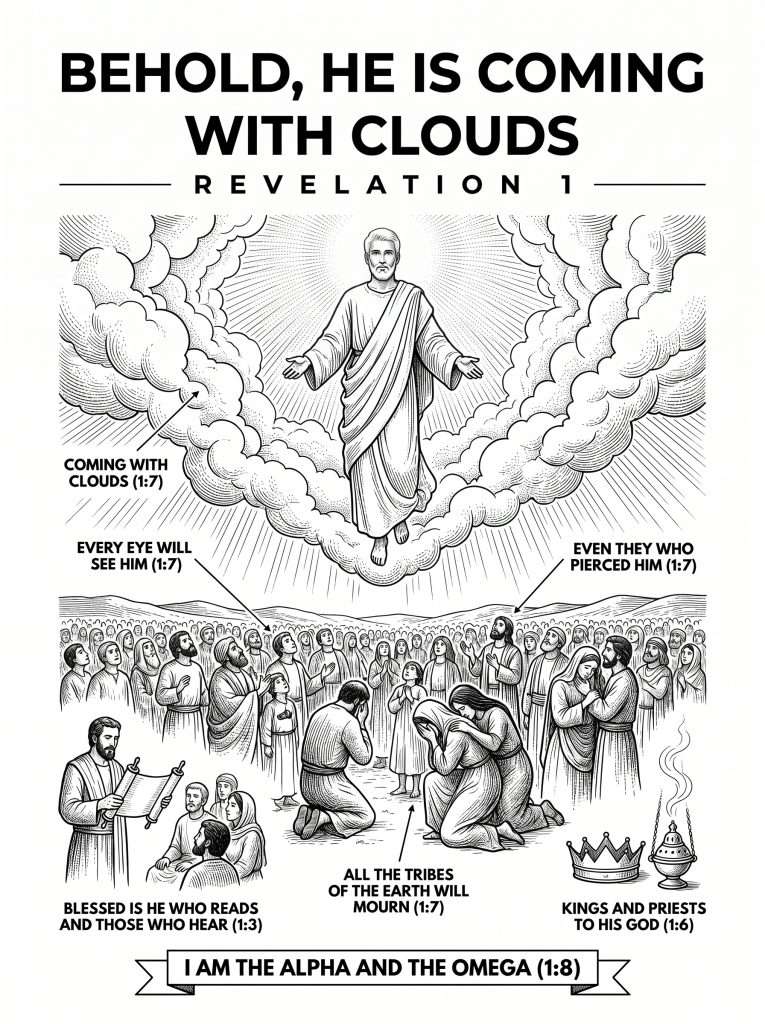
Behold, He is coming with clouds, and every eye will see Him, even they who pierced Him. And all the tribes of the earth will mourn because of Him. Even so, Amen.
“I am the Alpha and the Omega, the Beginning and the End,” says the Lord, “who is and who was and who is to come, the Almighty.”
The Revelation of Jesus Christ, which God gave Him to show His servants—things which must shortly take place. And He sent and signified it by His angel to His servant John, (Revelation 1:1)
When something is revealed, that something is a revelation. This is the revelation of Jesus Christ—not the revelation of John. John is the one relaying it to us, but it’s Jesus who is revealing it.
John begins his letter by explaining exactly what will be contained within: The Revelation of Jesus Christ, who John knew personally. In fact, John was likely Jesus’ best friend on earth during His ministry, since John said he himself was the disciple that Jesus loved in his own writing (John 13:23, 19:26, 20:2, 21:7, 21:20). Who better to receive such an important Revelation?
Just in case the reader is tempted to think that these things could not happen any time soon he is sure to add that these are things which must shortly take place. While the time scale may seem broad to the reader, we are living in a time when they could happen at any moment.
Notice that John is called His servant, or bondservant. Even though he was Jesus’ closest friend on earth, John is still described as a servant of Christ. This is how we should see ourselves—as servants of Christ. In the Western world, we aren’t as comfortable with being called slaves, but that’s what the word here means. We are slaves to Christ.
who bore witness to the word of God, and to the testimony of Jesus Christ, to all things that he saw. (Revelation 1:2)
John was no novice when it came to receiving and distributing God’s revelation. About himself, he says that he was the one who bore witness to the word of God, and to the testimony of Jesus Christ, to all things that he saw. Therefore, how better to both identify Jesus on his appearing and to reveal Himself to a trusted friend, and who better was there to handle well, the words he would receive?
John is testifying as an eyewitness. He’s going to share with us the vision and the revelation that Jesus gave him. This is similar to the way in which John claims eyewitness status in his gospel (John 19:35, 21:24).
Blessed is he who reads and those who hear the words of this prophecy, and keep those things which are written in it; for the time is near. (Revelation 1:3)
The word blessed is translated from the Greek word makarios. In modern English, we might translate this as privileged, happy, or to receive a good outcome. Something good happens to the person being described as blessed. In this case, it says that the one who reads the words of this prophecy is blessed.
Some translations say he who reads aloud. Personal Bibles are a relatively modern development. For most of history, people didn’t have their own copies of the Scriptures. Instead, Scripture was read aloud to groups of believers. These groups could be churches or regional gatherings, and often, the entirety of a text would be read aloud at once. The person who reads the prophecy aloud is blessed—they will receive something good for doing so.
But it doesn’t stop there. It also says that those who hear and heed the words are blessed. This blessing isn’t just for the reader; it’s for the hearer too, but only if they also heed what is written. The blessing doesn’t require that the person understand everything in Revelation to get the blessing. In fact, the sections of Revelation that give instructions are actually quite easy to grasp. Maybe the blessing is included precisely because Revelation has difficult-to-understand sections, and many may give up on finishing the book. This blessing offers special motivation for readers, hearers, and heeders, even if understanding some parts is out of reach.
That final phrase reminds us that Christ’s return is imminent. It’s essential to understand the difference between something being immediate and being imminent.
Imminent means it could happen at any moment. There is no other prophetic event that must take place before the return of Christ begins. Christ’s end-times events could begin at any moment.
Immediate, on the other hand, is different. Throughout history, many people have mistakenly believed Christ’s return would be immediate. Because of words like the time is near, they assumed He would come back right away. While Christ can return at any moment because His return is imminent, that doesn’t mean His delay falsifies the nearness of the events. It is near because His return could be tomorrow, or it could be in a thousand years. It’s near because nothing stands in the way—we know of no other prophetic event between now and His return events. It could happen at any time.
John, to the seven churches which are in Asia: Grace to you and peace from Him who is and who was and who is to come, and from the seven Spirits who are before His throne, (Revelation 1:4)
In the gospel account attributed to John, he does not identify himself by name; however, in this book, the author clearly identifies himself as John multiple times. He also explains that he is writing to the seven churches which are in Asia. These churches are spread across what was then known as Asia Minor, which is located generally in the area of modern-day Türkiye.
He isn’t just greeting his readers on his own behalf but also his letter is coming from a familiar triune entity; first from Him who is and who was and who is to come. Owing to the triune structure of the following lines, this most likely refers to God the Father, since next, he will add a greeting from the Spirit and Jesus.
He gives a mysterious statement when he says that it also comes from the seven Spirits who are before His throne. Multiple times he references the seven Spirits of God (Rv 1:4, 3:1, 4:5, 5:6). Some Bible teachers think these seven spirits are spiritual and/or angelic beings who minister before the throne but are not part of God’s trinity. However, more likely, this is a seven-fold manifestation of the Holy Spirit. Seven is often used to represent completeness. It is likely that he is seeing a manifestation of the full and complete Holy Spirit since the statement about God’s Seven Spirits is sandwiched between a mention of God the Father and God the Son. Admittedly, the statement is mysterious, and outside of the book of Revelation, we have very little in scripture to compare it to.
and from Jesus Christ, the faithful witness, the firstborn from the dead, and the ruler over the kings of the earth. To Him who loved us and washed us from our sins in His own blood, (Revelation 1:5)
Now, John will complete his greeting from the Trinity as he expresses that his letter is also from Jesus Christ, the faithful witness, the firstborn from the dead, and the ruler over the kings of the earth. This feels like a reference to the Psalm which says, I will also appoint him my firstborn, the highest of the kings of the earth. (Psalm 89:27) With this statement, John announces that the long-awaited day when Jesus takes his rightful ruling place above the world’s leaders is poised to take place. He then descends from this lofty concept to the very personal when he reminds us that Jesus is the one who loved us and washed us from our sins in His own blood.
and has made us kings and priests to His God and Father, to Him be glory and dominion forever and ever. Amen. (Revelation 1:6)
Not only is Jesus King the one who is ready to take charge of the earth, but he also has a role for believers to play in his kingdom plan. He has made us kings and priests to His God and Father. This reminds us of his promise that if we endure, we will also reign with Him (2 Timothy 2:12). It also echoes the ideas found in Peter’s writings where he explains that we are a chosen people, a royal priesthood, a holy nation, God’s special possession (1 Peter 2:9). It’s an invitation to have incredible responsibility, and undying purpose in the world to come. Christ’s coming kingdom will employ His faithful followers, appointing them to positions as king-priests, not for the glory of the individual but to Him be glory and dominion forever and ever. Amen.
Behold, He is coming with clouds, and every eye will see Him, even they who pierced Him. And all the tribes of the earth will mourn because of Him. Even so, Amen. (Revelation 1:7)
The main point of Revelation is this: Jesus is coming. This truth shapes how we live now, as Revelation will later explore the connection between His return and the rewards for faithfulness. For now, this opening passage reminds us to fix our eyes on the promise of His coming.
He turns toward some dark foreshadowing as he explains that Jesus is coming with clouds, which echoes how Jesus ascended and is promised to return (Acts 1:9-11). Unlike his ascension, his appearance won’t be for a small group of disciples to witness, but instead for the whole world to see, since every eye will see Him. It seems that this is not just limited to those who are alive on the earth since even they who pierced Him will see him coming with clouds. Although it will be a happy day for those who eagerly await His return, it won’t be so happy for many as all the tribes of the earth will mourn because of Him. Even so, Amen.
“I am the Alpha and the Omega, the Beginning and the End,” says the Lord, “who is and who was and who is to come, the Almighty.” (Revelation 1:8)
Now John pulls a quote from his later conversation with Christ. I am the Alpha and the Omega. This is like saying I am the A to Z, since Alpha and Omega are the first and last letters of the Greek Alphabet. He doubles down when he says that He is the Beginning and the End. His existence encompasses all of History, and He is the one who is and who was and who is to come. John’s words should be impossible to misunderstand. Jesus is claiming in no uncertain terms that He is the Almighty.
<< PREV | NEXT >>

